
The 48-hour SAT skill triage mindset
If you have two days until an SAT practice test, a school-administered exam, or a retake you can’t move, the goal isn’t “learn everything.” It’s to make the next 20 questions you do as high-leverage as possible. A 48-hour triage approach uses section analytics to decide what to practice next, based on what will likely convert into points quickly and reliably.
This is exactly where analytics-based prep shines. In getsharp, you can see performance by section and skill, then choose practice that targets the gaps most responsible for missed questions. The same logic works whether you use Sharp or a spreadsheet; the key is making decisions from evidence, not vibes.
Start with section analytics, not a full replan
First, pull up your most recent timed work: a full-length practice test, a Bluebook test, or at minimum two timed modules per section. You need enough data to trust patterns.
In your analytics, capture three numbers for each section (Reading & Writing, Math):
- Accuracy (overall and by skill)
- Time pressure signals (unfinished questions, rushing at the end, big time spikes)
- Error types (concept gap, misread, careless, or strategy)
In 48 hours, the most important output isn’t a study plan. It’s a ranked shortlist of skills to attack with your next 20 practice questions.
The triage rule for choosing your next 20 questions
Use this ranking formula to decide what you’ll practice next:
- High-frequency skills you’ll likely see again.
- Mid-difficulty misses (questions you were close on) before extreme hard misses.
- Fixable errors (process and pattern) before “I’ve never learned this.”
- Skills with clear repetition value (a single improvement helps multiple question types).
In practical terms: don’t spend your next two days chasing the rarest question type or the hardest one you’ve ever seen. Choose skills that show up, that you’re already partially equipped to answer, and that analytics says are actively costing you points.
Build a 3-bucket shortlist
Create three buckets using your section analytics:
- Bucket A: “Immediate points” — skills where you’re at ~50–80% accuracy and losing points due to repeatable mistakes.
- Bucket B: “Stabilizers” — skills where accuracy is okay, but time spikes or second-guessing cause misses.
- Bucket C: “Long-term rebuild” — skills where accuracy is consistently low and explanations feel like a new language.
Your 20 questions should mostly come from Bucket A, with a smaller portion from Bucket B. Bucket C gets a minimal slice (or none) in a strict 48-hour window.
Turn analytics into a precise set of 20 questions
A clean distribution that works for many students is:
- 12 questions from Bucket A (the two highest-impact skills)
- 6 questions from Bucket B (timing + consistency skills)
- 2 questions from Bucket C (only if it’s high-frequency and you can learn a usable shortcut)
Then add two constraints:
- Match the section mix to your score needs. If your Math score is lagging and you’re applying to STEM programs, allocate more of the 20 to Math.
- Keep the difficulty realistic. If analytics shows you’re missing medium questions, your next set shouldn’t be mostly hard.
Sharp’s skill analytics makes this selection faster because you can practice by skill and quickly see whether you’re improving or just repeating the same miss under a different surface story.
How to review each question so it actually raises your score
In 48 hours, review quality matters more than volume. For every missed question (and every guessed question), write a one-line “repair note” that you can reuse under pressure.
Use this review sequence:
- Classify the miss: concept, misread, careless, or strategy.
- Identify the trigger: what specific part of the prompt or setup should have changed your approach?
- Write a repeatable rule: a short sentence you can apply next time.
- Do one immediate retry: re-solve without looking, then compare.
This is where step-by-step explanations are useful—especially when they don’t just show the “right way,” but help you see where your original approach diverged. An AI tutor can accelerate this loop, and when you still feel uncertain, asynchronous human tutor messaging is a practical backstop because it prevents you from burning an hour stuck on a single confusion.
Timing triage using analytics, not guesswork
Section analytics often reveals that the problem isn’t purely skill—it’s timing. Two common patterns:
- Late-section collapse: accuracy drops sharply in the final third of a module.
- Time sink question types: a small set of skills consumes an outsized share of time.
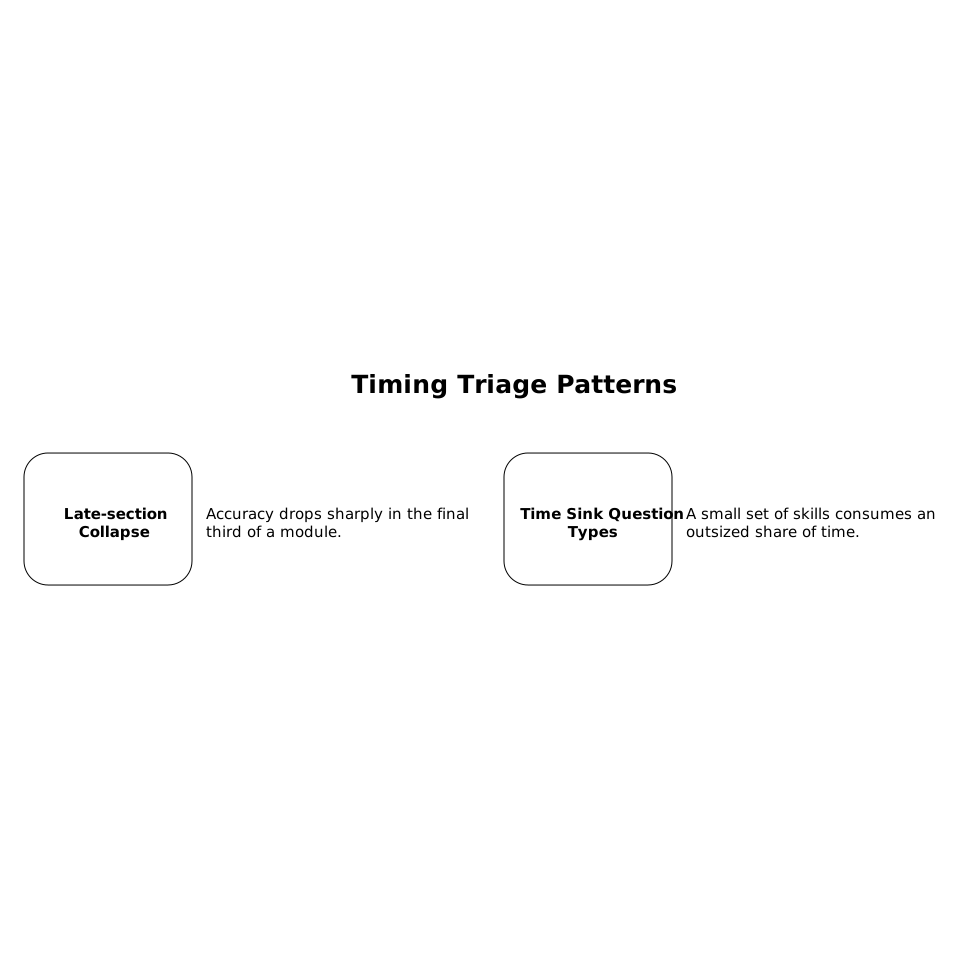
If you see either pattern, allocate part of your 20 questions to “timed micro-sets”: 5 questions under a strict timer that mirrors test conditions. The goal is not speed for its own sake; it’s protecting accuracy by preventing panic.
Operationally, treat this like a reliability problem: you’re trying to reduce failure modes under load. The same mindset shows up in engineering disciplines—designing for predictable outcomes rather than best-case performance. (If you like that framing, the idea of building guardrails resembles the logic in reliable event-driven frontends where systems are designed to handle retries and edge cases without breaking.)
A simple 48-hour schedule that fits real life
You don’t need an elaborate plan. You need a sequence that ensures you actually complete the triage loop.
Day 1
- 30–45 minutes: pull analytics, build Bucket A/B/C, select the 20 questions.
- 60–90 minutes: do 10 questions (mix of Bucket A and B), timed where appropriate.
- 45–60 minutes: review with repair notes + one retry per miss.
Day 2
- 60–90 minutes: do the remaining 10 questions, slightly harder only if Day 1 stabilized accuracy.
- 45–60 minutes: final review, compile a “test-day rules” list (5–10 bullets).
- 10 minutes: skim your rules list once, then stop. Sleep is worth points.
What success looks like after 20 questions
The output of this method isn’t perfection; it’s a measurable shift in the skills most responsible for missed points. After 20 questions, you should see at least one of these changes:
- Fewer repeated mistakes within the same skill category
- More consistent pacing (fewer end-of-module rushes)
- Greater confidence in your “repair rules” under time pressure
If none of these changed, the problem is usually selection, not effort: the questions were too hard, too random, or you reviewed passively. That’s the core promise of section analytics-driven triage—practice becomes targeted, not hopeful.
Vertical Video