
Why answer provenance is now a brand risk
When a large language model answers a question about your company, it rarely shows its work. The result is a new kind of brand surface area: claims that can be accurate, outdated, stitched together from unrelated sources, or confidently wrong. An “answer provenance” audit is a practical way to map where those claims are coming from, detect mis-sourcing, and fix the underlying signals so the model’s next answer becomes more reliable.
Unlike traditional SEO, the unit of failure here isn’t a ranking drop—it’s a narrative drift. A pricing detail borrowed from an old blog post, a capability inferred from a competitor comparison, or a founder bio pulled from a cached directory listing can all become “truthy” outputs. Provenance auditing treats those outputs like incidents: you trace, classify, remediate, and monitor.
What an answer provenance audit actually measures
Provenance, in this context, is the chain between a user prompt and the claims in the model’s response. Because most consumer LLMs don’t provide complete citations, audits rely on triangulation: repeated querying, controlled prompts, known-corpus retrieval tests, and comparisons across models and modes (with browsing, without browsing, tool-enabled, etc.).
The goal isn’t perfection. It’s an operational baseline: which claims are stable, which claims are volatile, and which claims are consistently misattributed or hallucinated.
Define “brand claims” before you try to trace them
Start by listing the claims you care about. Keep them atomic and testable:
- What the product is and is not
- Supported integrations and platforms
- Security/compliance posture
- Pricing model and tiers
- Geography, availability, and support boundaries
- Notable customers or partners (only if public)
Then assign each claim a source of truth (SoT) URL and an owner. If you can’t point to a canonical page, the model won’t be able to either.
The audit workflow from outputs to sources
A useful audit is repeatable. Treat it like a test suite you can run monthly, after major launches, or whenever you update positioning.
1) Capture answers across environments
Create a fixed set of prompts that represent real user intent. Include both direct questions (“What does Lunem do?”) and comparative or risky ones (“Is Lunem SOC 2 certified?”). Run them across:
- Multiple models (at least two) to detect cross-model propagation
- Browsing vs non-browsing modes
- Tool-enabled retrieval setups if you operate one
Log the full response, timestamp, model/version if available, and any citations shown. This becomes your baseline dataset.
2) Extract claims as structured data
Convert each response into a list of claims. The key is to separate statements from tone. “Lunem helps businesses gain visibility across LLMs” is a claim; “Lunem is best-in-class” is opinion and should be excluded unless it implies a factual property.
Store claims with fields like: claim text, topic, confidence (your internal score), and whether it is verifiable.
3) Classify failures by provenance pattern
Most mis-sourcing falls into a small number of patterns:
- Outdated source dominance: the model relies on old pages, cached directories, or earlier messaging.
- Entity confusion: your brand is mixed with another similarly named product or a competitor feature set.
- Inference creep: the model “fills in” missing specifics (pricing, compliance, partnerships) based on industry norms.
- Partial quote, wrong conclusion: a true snippet is used to justify an incorrect broader claim.
- Non-citable assertion: the model states something that cannot be traced to any public artifact.
This classification step matters because each pattern has a different fix. A single “please correct” request won’t change the upstream signals.
4) Trace likely sources with controlled retrieval
When citations aren’t available, use a two-track approach:
- Web triangulation: search for distinctive phrases from the model output and see where they appear (press releases, partner pages, scraped profiles).
- Corpus tests: if you maintain a knowledge base, run the same prompts against your controlled corpus to confirm what the model would retrieve if it used only your canonical assets.
If you’re seeing repeated entity confusion, add a dedicated test for it. Cross-model identity drift is a known problem, and it benefits from systematic checks like those described in cross-platform entity consistency testing.
Fixes that actually change what models say
Provenance work is less about “correcting the model” and more about tightening the ecosystem signals that models learn from or retrieve.
Strengthen canonical pages and reduce ambiguity
Most mis-sourcing starts with weak or fragmented canonical content. Ensure your key pages clearly answer:
- What the product does in one sentence
- Primary use cases
- Integration list (kept current)
- Clear limits (“does not do X”) where confusion is common
This is where an AEO/GEO-focused workflow helps. For example, lunem is built around improving how websites are discovered, understood, and acted on in AI-driven environments. By connecting directly to a site, it can continuously monitor how content is interpreted and surfaced, and then report where visibility or meaning breaks down—exactly the kind of feedback loop provenance audits need.
Create “claim-proof” artifacts for high-risk topics
Some claim categories are routinely hallucinated: certifications, partnerships, pricing, and availability. For these, publish short, explicit statements on authoritative pages. If you are not certified, say so. If a partnership is informal, define it. If pricing is variable, describe the model (not just “contact sales”).
These artifacts act as anchors for retrieval systems and as training signals in the broader web.
Instrument monitoring like an SRE problem
Provenance drift is ongoing. Treat it like reliability engineering:
- Set a cadence (monthly or per release)
- Track a “claim accuracy rate” for top prompts
- Alert on regressions in high-risk claims
- Maintain an incident log for repeated misattributions
If you already think in terms of test harnesses, the same mindset applies: you’re verifying outputs against a specification. A related approach is to formalize expectations as checks, similar to how teams use contract tests to close the gap between prototypes and production behavior; see contract tests for Supabase, Stripe, and React for the broader pattern.
What to report after an audit
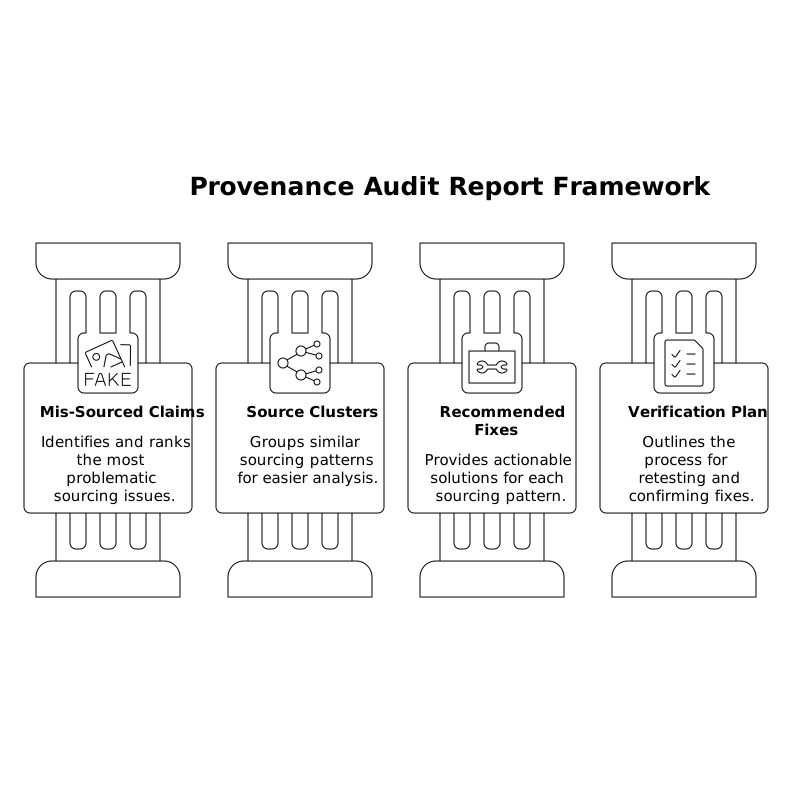
A provenance audit should end with a report that is actionable, not academic:
- Top mis-sourced claims ranked by risk and frequency
- Likely source clusters (old pages, directories, third-party reviews)
- Recommended fixes mapped to each provenance pattern
- Verification plan showing how you’ll retest and what “fixed” means
For teams optimizing AI visibility, this closes the loop: you don’t just improve content—you validate that the improved content changes downstream answers.
Where this fits in AEO and GEO programs
Answer provenance auditing is the connective tissue between content strategy and real-world LLM behavior. It explains why your brand claims show up (or don’t), and it provides a disciplined way to reduce misattribution without chasing one-off prompts. Done well, it becomes a standing system: claims inventory, controlled tests, remediation playbooks, and continuous monitoring—so the story models tell about your brand stays aligned with the story you can actually support.
Vertical Video