
Why AI agents fail when they leave chat and start executing
Most teams can get an AI agent to sound competent in a demo. The real failures start when the agent must read from and write to production systems: CRM, ERP, billing, ITSM, commerce platforms, and identity layers. The gap is rarely “model quality” alone. It’s usually a bundle of missing guarantees around data, permissions, side effects, observability, and human control.
The Agent Readiness Score is a field-tested audit: a structured way to measure what breaks when an AI agent moves from conversational assistance to real execution. Instead of asking “Is the agent smart enough?”, it asks “Is the environment and workflow safe, testable, and reversible enough for automation?”
What the Agent Readiness Score measures
Think of the score as a checklist with weighted dimensions. You can implement it as a spreadsheet, a CI gate, or a release review template. The point is consistency: every new workflow (refunds, address changes, quote updates, renewals) should be audited the same way before it’s allowed to run unattended.
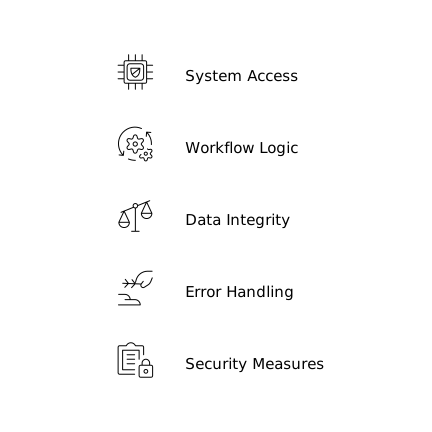
Below are the most common dimensions that determine whether execution is reliable.
1) System access and permissions fidelity
Agents often run with “integration-user” credentials that are too powerful or too vague. The audit should verify:
- Least-privilege scopes mapped to specific actions (e.g., “create return authorization” vs “admin commerce settings”).
- Policy alignment with real-world constraints (refund windows, verification steps, approval thresholds).
- Audit trails at the system-of-record level, not only in the agent logs.
If you can’t answer “Which exact permission enabled this write?” you don’t yet have execution readiness.
2) Data readiness and entity consistency
In chat, an agent can be fuzzy. In CRM/ERP execution, fuzziness creates incorrect writes. The audit should check whether the agent can reliably resolve entities and identifiers:
- Canonical IDs for customers, orders, invoices, subscriptions, and tickets.
- Disambiguation rules when multiple matches exist (same email, shared domain, merged accounts).
- Cross-system consistency when the “truth” may differ across tools.
This is where many teams benefit from explicit consistency tests rather than relying on prompt quality alone. If you want a deeper approach, the internal guide on cross-platform entity consistency testing for AI assistants is a practical complement to this audit.
3) Side-effect safety: idempotency, retries, and duplicate prevention
Execution systems fail in normal ways: timeouts, transient 500s, webhook delays, and queue replays. If your agent “tries again” without guardrails, it can double-refund, duplicate a case, or create multiple shipments.
The score should require:
- Idempotency keys for any non-read action.
- Retry strategy that differentiates between safe retries (reads) and risky retries (writes).
- Dead-letter handling for operations that need human inspection after repeated failure.
For teams building event-driven frontends around agents, the internal article on idempotency keys, retries, and dead-letter queues maps directly to this dimension.
4) Workflow boundaries and “done” definitions
Many agent deployments fail because “resolution” is defined conversationally (“customer seems happy”) rather than operationally (“refund recorded in ledger; confirmation email sent; ticket annotated; inventory updated”).
Your audit should require every workflow to declare:
- Entry criteria: what must be known before execution begins (order ID, customer verification, eligibility checks).
- Exit criteria: which systems must reflect completion.
- Non-goals: what the agent must never attempt (e.g., changing tax settings, closing disputes).
This prevents agents from “completing” in chat while leaving the back office inconsistent.
5) Human control design for partial and full takeovers
Execution readiness increases sharply when humans can step in without breaking context. The audit should check whether the product supports:
- Approvals for sensitive actions (refund amount above threshold, contract changes, address changes near shipment).
- Partial handoffs where a human supplies missing inputs and the agent continues.
- Full takeovers where an agent can be paused and an agent-to-human transfer is clean.
This is not just UX. It’s risk management. “Hybrid Intelligence” patterns are often what make real CRM/ERP execution acceptable to operations teams.
6) Observability and forensic debugging
When an agent makes a wrong update, your team needs to answer three questions quickly: what did it decide, what did it do, and what did the downstream system accept?
The audit should require:
- Structured logs for tool calls, parameters, and results (with sensitive redaction).
- Correlation IDs across systems so you can trace one customer interaction through CRM, ERP, and billing.
- Replay capability in a safe environment to reproduce incidents.
Without this, teams compensate by restricting the agent so heavily that it never reaches meaningful automation.
7) Change management: testing before production
Agents change frequently: prompts, policies, tool schemas, and routing logic evolve. Your readiness score should penalize any workflow that cannot be validated automatically before release.
At minimum, require:
- Contract tests for every integration endpoint and schema.
- Simulation with representative conversations and edge cases.
- Policy regression checks so new instructions don’t weaken guardrails.
This is where teams discover the hidden truth: most “agent bugs” are integration or policy drift problems, not model hallucinations.
How to implement the score in practice
A useful Agent Readiness Score does two things: it’s easy to repeat, and it creates clear release gates. A common pattern is a 0–5 rating per dimension, weighted toward the highest-risk areas (writes to billing/ERP, customer identity changes, and irreversible actions). Then define deployment tiers:
- Tier 0: read-only assistance (no writes).
- Tier 1: writes allowed with approvals and strict guardrails.
- Tier 2: autonomous execution for low-risk workflows with strong observability and idempotency.
- Tier 3: autonomous execution across multiple systems with supervisor oversight and continuous evaluations.
The score becomes a shared language between product, engineering, operations, and compliance: it explains why one workflow can go live autonomously while another must stay behind approvals.
Where platforms like Typewise fit
Teams can assemble these capabilities themselves, but the operational burden compounds: orchestration, policy enforcement, multi-agent routing, approvals, simulation, and evaluation loops all need to work together.
Typewise positions itself as an AI-native layer above existing systems that can read and write across CRM, ERP, billing, ITSM, commerce, and knowledge tools, while keeping humans in control through approvals and takeovers. If you want a reference point for what “execution-ready” looks like when delivered as a platform rather than bespoke glue, start with typewise.app.
Regardless of platform choice, the audit lens remains the same: focus less on how fluent the agent sounds, and more on whether your execution surface is testable, permissioned, observable, and reversible.