Start with your risk model, not your toolset
A meeting transcript is rarely “just notes.” It can contain personal data, customer commitments, health information, financial details, trade secrets, legal advice, and negotiation history—often in the same call. A practical retention policy for AI transcripts has to balance two forces that pull in opposite directions: compliance pressure to minimize stored data, and operational pressure to preserve institutional memory.
The fastest way to get this wrong is to set a single global retention period. The safer pattern is to classify transcripts by risk and business value, then attach a retention rule to each class. That lets you shorten retention where exposure is high (or value decays quickly) without destroying the few conversations you will need to defend decisions, audit changes, or understand why a customer was promised something.
Define what “meeting data” includes
Before you can retain or delete, you need a precise scope. Most teams underestimate how many artifacts an AI notetaker produces.
- Raw audio/video recordings (often highest sensitivity).
- Verbatim transcripts (searchable, frequently copied).
- AI summaries and action items (condensed, still potentially sensitive).
- Highlights, clips, and playlists (shareable, can be decontextualized).
- Metadata such as attendee lists, timestamps, topics, speaker labels, and meeting titles.
- Downstream sync copies pushed into Slack, Salesforce, HubSpot, Notion, Asana, and other systems.
A retention policy should state whether rules apply equally to each artifact or whether, for example, recordings are deleted earlier while summaries persist longer for decision continuity.
Build a transcript classification system that actually holds up
Keep classification simple enough that people will follow it, but strict enough to satisfy auditors. Most organizations do well with four buckets:
1) Routine operational meetings
Standups, project updates, internal syncs. Value decays quickly; transcripts often include candid employee context.
2) Customer and revenue meetings
Sales calls, onboarding, QBRs, support escalations. High institutional value, but also higher regulatory exposure depending on the customer.
3) Regulated or high-sensitivity meetings
Anything likely to include health data (HIPAA), payment data, legal strategy, HR investigations, or confidential security information. Here, “keep everything forever” is usually indefensible.
4) Decision and governance records
Architecture reviews, launch approvals, pricing changes, incident postmortems. These are the meetings you will need months later to answer “why did we do that?” This bucket is where you protect institutional memory deliberately, rather than accidentally.
If you already maintain product decision artifacts, align meeting retention to them. For example, a launch approval transcript can be retained as long as the underlying decision log or PRD history is retained; otherwise your meeting archive becomes a shadow system. If your team is formalizing decisions, pairing meeting notes with a reusable decision log format can reduce how long you need to store verbatim transcripts while keeping the rationale accessible.
Choose retention periods by data minimization plus utility
Retention is a business decision constrained by legal and contractual requirements. A defensible policy documents the logic: shorter by default, longer only where there is clear value.
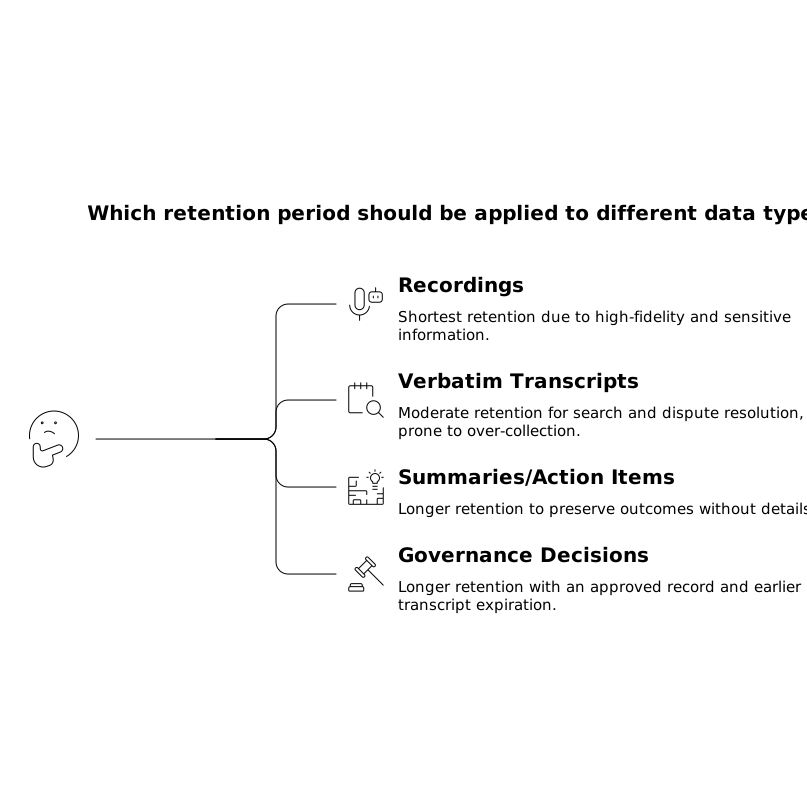
- Recordings: shortest retention, especially for regulated or HR topics. Recordings are high-fidelity and often contain incidental sensitive information.
- Verbatim transcripts: moderate retention; powerful for search and dispute resolution, but also the easiest to over-collect.
- Summaries/action items: longer retention is often justified; they preserve outcomes without preserving every detail.
- Governance decisions: longer retention, but consider storing an approved “decision record” artifact and expiring the raw transcript earlier.
Where you can, turn the retention policy into automation. Modern platforms such as Fathom support configurable retention controls, which helps avoid policy-by-slide-deck—rules that exist in documentation but not in systems.
Don’t forget the copies created by integrations
A common compliance failure is deleting the transcript in the notetaker while leaving permanent copies elsewhere. If summaries are synced into a CRM, the CRM becomes the system of record and should inherit retention and deletion behavior.
Map your data flows:
- Where do transcripts land by default (personal workspace, team folder, shared library)?
- Which systems receive a copy (Slack channels, deal records, ticketing tools, knowledge bases)?
- Who can export, download, or forward notes outside approved repositories?
Retention needs to be consistent across systems, or you risk both over-retention (keeping sensitive data too long) and under-retention (losing the only copy of a key decision).
Design for access control and “need to know” search
AI transcript search is a double-edged sword: it’s the feature that creates institutional memory, and the feature that makes data leakage fast. A robust retention policy is inseparable from an access policy.
- Default private, explicit sharing: reduce accidental exposure of sensitive calls.
- Role-based access: separate coaching views, sales management visibility, and general team access.
- Scoped global search: search should respect permissions, folders, and team boundaries.
- SSO and lifecycle controls: ensure departing employees lose access immediately; SCIM helps automate this.
For organizations using AI Q&A over transcripts (for example, querying past calls to surface patterns), clearly define which buckets can be queried and which should be excluded or redacted.
Operationalize deletion, legal holds, and audits
A retention policy that cannot survive edge cases will be ignored. Define three mechanics:
Automated deletion
Deletion should be time-based, category-based, and auditable. “Deleted” should mean deleted from active systems, not merely hidden.
Legal holds
You need a way to pause deletion when litigation, investigations, or contractual disputes require preservation. Holds should be narrow (specific users, meetings, or date ranges) to avoid turning a hold into a blanket archive.
Audit readiness
Document how you prove compliance: retention settings, access logs, export events, and administrative changes. This is also where SOC 2 practices and GDPR alignment matter in vendor selection and internal process design.
Preserve institutional memory without hoarding raw data
If you retain everything, you will eventually retain the wrong thing. If you delete everything, you will repeat mistakes and lose context that keeps teams aligned. The middle path is intentional compression:
- Promote outcomes: store approved summaries, action items, and decisions as durable artifacts.
- Demote raw verbatim text: retain for a shorter window unless the meeting falls into governance or regulated categories that require a different approach.
- Standardize naming and foldering: so teams can find “the decision” without relying on full transcript search.
- Run periodic reviews: treat retention like any other operational control—measured, adjusted, and owned.
One practical test: if a new teammate joins, can they understand the last 90 days of key decisions without needing access to every sentence ever spoken? A good policy makes that possible while reducing your long-term exposure.
Rollout plan that sticks
Adoption matters more than perfect theory. Roll out in phases:
- Phase 1: define buckets, set default retention, and enable core access controls.
- Phase 2: fix integration sprawl and ensure downstream systems follow the same rules.
- Phase 3: add legal holds, audits, and a lightweight governance process for “decision meetings.”
To keep the policy from becoming shelfware, publish a one-page version for employees and a detailed version for security/legal. Then enforce it through configuration, not reminders. If you’re already hardening other operational systems, apply the same mindset here: reliable automation, clear ownership, and predictable failure modes.