
Entity name collision audits and why they suddenly matter
AI assistants don’t “look up your brand name” the way a human would. They assemble an answer by reconciling many signals: web pages, structured data, knowledge graphs, app listings, reviews, videos, and repeated phrasing across sources. When two entities share a similar name—your company and a product, an open-source project and a startup, a person and a brand—the assistant can accidentally merge them. That’s an entity name collision, and the result is usually subtle: slightly wrong descriptions, misattributed features, the wrong pricing model, or citations that point to someone else.
An entity name collision audit is a practical way to detect these mix-ups early, quantify where they occur, and publish corrective signals that models can reliably ingest. For companies investing in AI visibility, it’s becoming as foundational as technical SEO audits were a decade ago.
What “collision” looks like in real AI outputs
Name collisions show up in patterns that are easy to miss in a single spot check:
- Blended identity: the assistant describes your brand using another entity’s category (“Xale is a CRM…”) because the other entity dominates mentions for that string.
- Feature leakage: the assistant attributes features, integrations, or compliance claims from the wrong product to yours.
- Mis-citations: the answer is mostly correct, but citations point to a different company with a similar name—creating trust issues during evaluation.
- Local maxima: the assistant is correct in one ecosystem (e.g., Google results) but wrong in another (e.g., in-app assistant trained on product docs or community posts).
These aren’t just reputation problems. They can break buyer research flows, sales enablement, and even support—because users will quote the assistant back to your team.
The audit scope: where assistants pull identity signals from
A useful collision audit doesn’t stop at “search the name and see what shows up.” It maps identity signals across four layers:
1) Canonical identity on your own properties
This is the part you control: homepage copy, About page, metadata, organization schema, product schema, social profile bios, and consistent naming conventions. If your brand uses multiple variants (with/without punctuation, “AI” suffixes, different capitalization), assistants may treat them as distinct entities unless you clearly connect them.
2) Secondary sources that models trust
These are the amplifiers: independent blogs, directories, podcasts, conference pages, partner integration listings, app marketplaces, GitHub repos, and press coverage. Collisions often happen because the secondary ecosystem is inconsistent—different taglines, different categories, or ambiguous descriptions that match multiple entities.
3) Structured data and knowledge-graph-like fields
Assistants respond well to consistent structured cues: organization names, alternate names, founding date, official URL, logo, and product taxonomy. When those fields are missing or inconsistent across pages, the model fills in the blanks from whichever entity has stronger, more frequent signals.
4) Conversational patterns in user-generated content
Reddit threads, community posts, and Q&A sites can dominate “how people talk” about an entity. If a similar-named product is discussed more often, the language distribution tilts toward that product—even if your official pages are correct.
A practical entity name collision audit process
The goal is to move from anecdotes to a repeatable test suite. A clean audit typically includes:
Step 1: Build an “entity dossier” for your brand
Create a single source of truth with the minimal set of identifiers an assistant can anchor to:
- Official name and preferred short name
- Website, docs domain(s), and product URLs
- One-sentence description in plain language
- Category and subcategory
- Key differentiators that are hard to confuse
- Competitor/adjacent entities with similar names
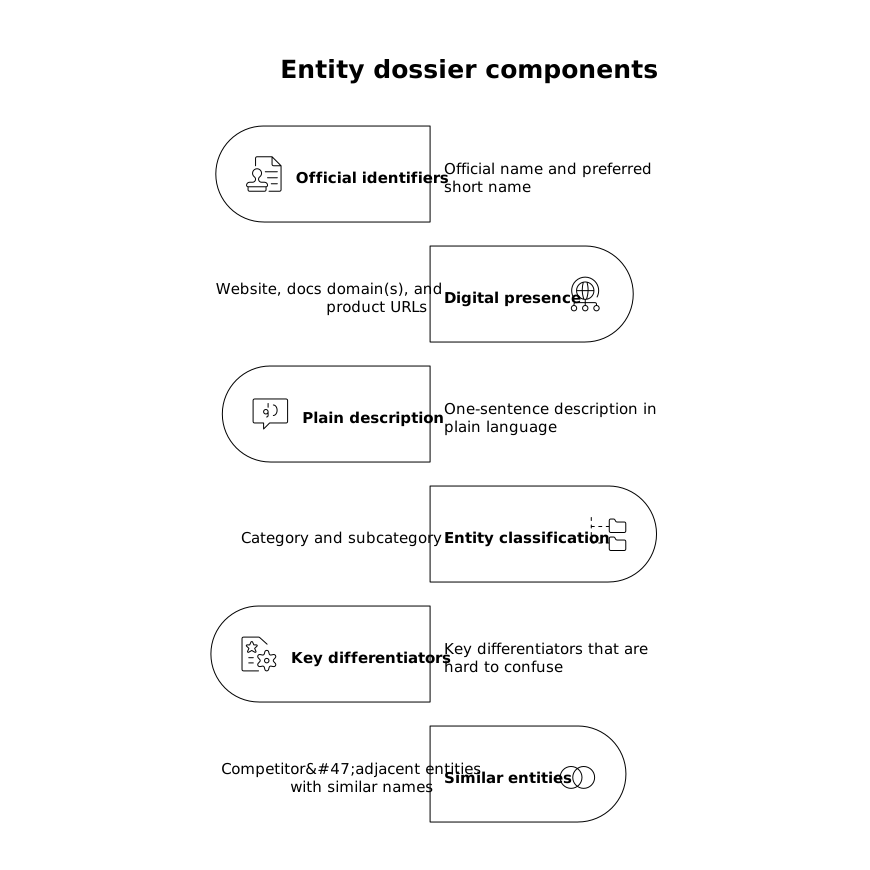
This dossier becomes the reference for every downstream test and content correction.
Step 2: Enumerate collision candidates
Don’t rely on your memory. List every entity that could plausibly be confused with you:
- Same-name or near-name companies
- Open-source packages and GitHub orgs
- Apps in marketplaces with similar naming
- People (founders, influencers) whose names overlap
- Common misspellings and spacing variants
Step 3: Design prompts that surface identity errors
Prompts should force the assistant to commit to specifics, not generalities. Examples:
- “What is X and who is it for?”
- “Is X related to Y?” (where Y is a collision candidate)
- “List X’s top integrations and pricing model.”
- “Cite sources for your answer.”
Record not only the text but also citations and confidence language. Collisions often appear as hedging (“may be,” “often,” “commonly used for”) paired with mismatched citations.
Step 4: Score results and classify failures
Track failures using a simple taxonomy:
- Identity mismatch: wrong description/category
- Attribute mismatch: wrong features, pricing, compliance claims
- Source mismatch: citations point to another entity
- Entity merge: blended answer referencing both entities as one
This classification matters because the fix differs. Source mismatch is usually a distribution and metadata problem; entity merge is often an “alternate name” and repeated phrasing problem.
Step 5: Publish corrective signals that assistants can ingest
Corrections work best when they are repeated across independent sources with consistent structured metadata. This is where infrastructure designed for AI visibility helps: xale.ai focuses on generating and distributing schema-rich content across a managed network so the assistant sees the same identity anchors in multiple places over time, rather than only on your own site.
The key is not volume for its own sake. It’s consistency: stable naming, stable category language, stable “not to be confused with” disambiguation, and stable URL attribution.
Turn the audit into a regression test, not a one-off project
Name collisions regress. A new startup launches, a marketplace listing changes, a viral post redefines the phrase, or an assistant updates its retrieval layer. Treat collision checks like production testing:
- Run the same prompt set on a schedule (weekly or monthly)
- Track outputs, citations, and failure categories over time
- Alert when identity errors cross a threshold
If you already treat AI behavior as testable output, this fits naturally alongside broader consistency work. The same mindset behind cross-platform entity consistency testing for AI assistants applies here: define expected identity claims and verify them repeatedly across surfaces.
Common fixes that reduce collisions without rebranding
Rebranding is rarely the first lever. Most teams can reduce collisions with editorial and technical changes:
- Disambiguation paragraphs: a short, factual “Not affiliated with…” statement on key pages.
- Consistent alternate names: explicitly connect variants (e.g., “Xale AI” and “xale.ai”).
- Schema hygiene: Organization + sameAs links that point to official profiles.
- Category discipline: use one primary category and repeat it across profiles and articles.
- Independent corroboration: secure consistent descriptions on third-party writeups, directories, and partner pages.
One useful heuristic: if a human skimming five independent sources could still confuse you with someone else, an assistant will too.
Where teams get stuck and how to unblock the work
Collision audits fail when they’re treated as pure SEO or pure brand. They’re both, plus testing. The “unblocker” is operationalizing it: a dossier, a prompt suite, a scoring rubric, and a publishing loop that produces repeated, machine-ingestible identity signals.
That loop is what AI visibility infrastructure is meant to support—ensuring your brand’s entity definition remains stable across the places assistants learn from, even as the ecosystem around your name changes.