
Why the join key matters more than the test design
Cross-channel incrementality tests often fail for a reason that looks boring on paper: the join key. If your paid social data calls something a “campaign,” your ad server calls it a “placement,” and your CRM stores a UTM string that only sometimes matches either, you don’t have one experiment—you have several partially overlapping ones. The result is corrupted measurement: lift attributed to the wrong channel, exposure miscounted, and budgets reallocated based on artifacts rather than causal impact.
The “join-key trap” is the failure mode where misaligned campaign IDs (and related identifiers) silently break the mapping between treatment, exposure, and outcome across systems. Incrementality testing is uniquely sensitive to this, because its credibility depends on clean cohort assignment and consistent counting. If the join is wrong, the math can still look rigorous—confidence intervals, p-values, dashboards—but it’s rigorous about the wrong underlying table.
How misaligned campaign IDs corrupt cross-channel lift
1) Exposure becomes a moving target
Incrementality depends on knowing who was eligible to be exposed, who was exposed, and when. Misaligned campaign identifiers create a subtle but damaging shift: “exposure” is defined differently in each dataset. On-platform data may record impressions by campaign ID, an ad server may group by line item, and analytics may only capture a last-click UTM parameter. When you join these tables, you can end up counting exposures that have no corresponding outcome records—or outcomes that appear to have occurred without any exposure.
This is especially common when a channel’s campaign ID is regenerated (for example, after duplication, naming changes, or trafficking updates), while your downstream system continues to store the old ID. The test still runs; the mapping quietly drifts.
2) Treatment and control leakage gets hidden in the join
A classic risk in incrementality is leakage: control users receive treatment, or treated users are misclassified as control. Misaligned join keys make leakage harder to detect because it presents as “missingness” rather than a classification problem. If your test assignment is stored against one ID and your delivery logs use another, the join can drop rows and shrink the apparent overlap between assignment and exposure. You might conclude the holdout was clean when the reality is that you simply failed to connect the evidence.
3) Cross-channel duplication inflates lift
When one real-world campaign is represented by multiple IDs across tools, your joins can accidentally turn one observation into many. For example, a single campaign may be split by region in one platform, by audience in another, and by creative in a third. If you join on inconsistent keys, the same conversion can be replicated across joined rows and then aggregated back up—creating inflated incremental conversions or revenue.
This is not a theoretical edge case. It happens whenever join granularity differs (campaign vs. ad set vs. creative) and you “bridge” with a partial key like campaign name that is not unique.
4) Time alignment breaks and creates false causality
Incrementality often hinges on precise time windows: pre-period vs. test period, exposure windows, conversion windows, and lag. Misaligned campaign IDs frequently come with misaligned timestamps because data arrives via different refresh cycles and attribution windows. If you join on an ID that maps inconsistently across periods, you can create the appearance of lift simply by shifting conversions into the test window for one dataset but not the other.
The most common join keys that fail in practice
Teams rarely choose a bad join key on purpose. They choose what is available. The trap is that what is available is not always stable, unique, or shared across systems.
- Campaign name: human-readable, editable, and often reused. Great for dashboards, fragile for joins.
- Platform campaign ID: stable within a single platform, but not shared cross-channel. Also vulnerable when data is exported from different accounts or connectors that normalize IDs differently.
- UTM parameters: useful for web analytics, but frequently incomplete (missing on view-through), overwritten (by redirects), or inconsistent (case, separators, naming standards).
- Ad server line item IDs: strong for delivery logs, weak when outcomes are tracked without the ad server present (in-app, offline, CRM).
- Creative IDs: too granular for many incrementality readouts; mismatched granularity multiplies rows.
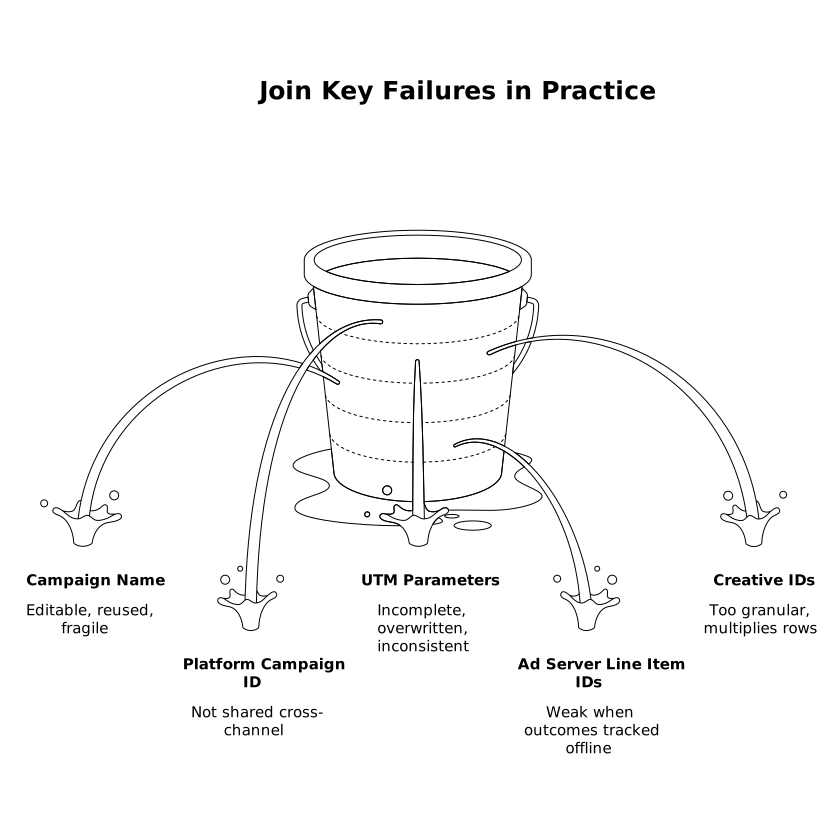
The key insight: incrementality tests need one canonical experiment spine that every dataset can attach to without ambiguity. Without that spine, you’re stitching together approximations.
A practical playbook to avoid the join-key trap
Define a canonical campaign key, then map everything to it
Start by creating a canonical identifier that is independent of any one platform. This can be an internal campaign key (for example, a UUID or structured code) stored in a governance table. The goal is not to replace platform IDs; it’s to provide a stable join target that survives renames, duplications, and trafficking changes.
Then maintain explicit mappings from each platform’s IDs, names, and tracking parameters to that canonical key. Treat this mapping as part of the experiment design, not as post-processing.
Enforce uniqueness and granularity rules before analysis
Before any lift calculation, run checks that answer three questions:
- Is the join key unique at the intended level? If “campaign name” maps to multiple platform IDs, you have ambiguity.
- Is granularity consistent? If outcomes are at campaign level but exposures are at ad level, aggregate exposures first (or redesign the spine).
- Is the mapping stable over time? A key that changes mid-test is effectively a treatment change.
These checks are not busywork. They are what prevent statistically confident but causally meaningless results.
Standardize naming and tracking as a pipeline, not a spreadsheet
Most organizations attempt to solve join-key problems with conventions: naming templates, UTM guidelines, campaign briefs. Those help, but the trap persists because manual enforcement breaks under volume. A better approach is to operationalize standardization in the data pipeline so that normalization is continuous and auditable.
This is where marketing data infrastructure becomes part of measurement quality. Funnel.io is designed to collect performance data from ad platforms, analytics, and CRM systems, then normalize fields through transformations like naming harmonization and KPI calculations. In incrementality work, that kind of standardization reduces the risk that the “same” campaign is represented by incompatible identifiers across tools.
Prefer deterministic joins, and be explicit when you must use fuzzy logic
When deterministic keys exist (a shared experiment ID, a click ID, a stable internal campaign key), use them. If you must rely on fuzzy joins—string matching campaign names, parsing UTMs, reconciling inconsistent casing—treat the result as a model with error, not as truth. Quantify match rates, audit samples, and report how much spend or how many conversions fall outside the matched set.
Build “join diagnostics” into every incrementality readout
Incrementality dashboards should not only show lift; they should show data integrity. Useful diagnostics include:
- Percentage of spend matched to the canonical key
- Percentage of conversions matched
- Count of one-to-many and many-to-one mappings
- Rows dropped due to missing keys
- Pre vs. post mapping stability
When these diagnostics move, your test interpretation should move with them.
What “good” looks like in cross-channel incrementality measurement
A reliable cross-channel incrementality test doesn’t depend on heroics in a notebook at the end. It depends on a shared measurement spine: consistent identifiers, consistent granularity, and consistent time logic. When campaign IDs are misaligned, the experiment becomes a reconciliation project—and lift becomes a side effect of join behavior.
Fixing the join-key trap is less about picking a better statistical method and more about making the underlying data joinable by design. Once the identifiers line up, incrementality stops being a debate about whose dashboard is right and becomes what it should be: an answer to what actually caused the outcome.
Vertical Video