
Cycle Spillover Forensics and why it beats guesswork
Cycle spillover is rarely a single “planning problem.” It’s a pattern: the same kinds of work roll over, sprint after sprint, until the cycle becomes a holding pen instead of a delivery mechanism. Cycle spillover forensics is a lightweight way to identify what keeps slipping, why it slips, and what to change next cycle—without adding process weight.
The goal isn’t perfect predictability. It’s a tighter feedback loop: detect the causes early, reduce recurring rollover, and protect focus for both engineering and product. Teams using structured cycle planning tools (including linear.app) have an advantage here because the data you need—scope changes, status churn, blocked time, and unplanned work—already exists in the workflow.
The three issues that cause most sprint rollovers
Across teams and codebases, spillover tends to cluster into three repeat offenders. You can treat them as a diagnostic order: start with the most common and easiest to confirm, then move to the more subtle causes.
Issue 1: Scope volatility disguised as “just one more thing”
Spillover often isn’t caused by poor estimation—it’s caused by scope change mid-cycle. The work that rolls over is frequently work that was never truly planned as it exists now. Typical signals include:
- Issues that gain new acceptance criteria after the cycle starts.
- Subtasks added mid-cycle to “finish it properly.”
- Design or stakeholder feedback that turns a small change into a rework loop.
- Engineers bouncing between “almost done” items because definitions keep moving.
Forensics check: Pick the top 5 rolled-over issues from the last cycle. For each, compare the original scope (description, checklist, linked spec) to what shipped or is currently required. If the delta is meaningful, the root cause is volatility, not capacity.
Fix next cycle: Introduce a simple “scope lock” rule: after day 1 (or after kickoff), changes are either (a) explicitly swapped into the cycle by removing equivalent scope, or (b) queued for the next cycle unless the change is truly urgent. The rule is less about control and more about making tradeoffs visible at the moment they happen.
Issue 2: Hidden dependencies and waiting time
Many teams plan for effort, but they execute inside a dependency web: approvals, reviews, other teams’ APIs, environment access, data migrations, release windows, and even customer timelines. When waiting time is invisible, the cycle quietly runs out.
Common patterns:
- Issues sit “In Progress” while blocked on review or external input.
- Work is “ready” but can’t ship due to release coordination.
- Integration or platform work bottlenecks multiple tickets late in the cycle.
Forensics check: For rolled-over issues, classify the time spent into two buckets: active work time vs waiting time. You don’t need perfect tracking—just a best-effort reconstruction from comments, status changes, PR timelines, and “blocked” indicators. If waiting dominates, your problem is dependency management, not sprint sizing.
Fix next cycle: Add a dependency “preflight” step during planning. Before an issue is cycle-committed, confirm at least one of these is true: the dependency is already done, an explicit handoff date exists, or there’s a fallback plan. If your tool supports it, make blocked work unmistakable (a dedicated blocked state, label, or workflow signal), so waiting time is not mistaken for execution.
Issue 3: Work in progress overload and throughput collapse
Teams often roll over work because too much is started at once. When work in progress (WIP) climbs, everything slows: context switching increases, review queues grow, and “almost done” piles up. The cycle ends with a lot of motion but not enough completion.
Indicators:
- Many issues are partially complete near cycle end.
- PRs linger without review bandwidth.
- Engineers start new items because “the current one is blocked,” but nothing gets closed.
Forensics check: Look at the ratio of started-to-finished issues in the cycle. If the team started far more than it finished, and rollover is concentrated in “nearly there” items, you likely have a WIP problem. In a system like Linear, this shows up as lots of issues bouncing among active states and a spike of last-minute status changes.
Fix next cycle: Use a WIP policy that is small enough to matter but simple enough to follow. For example: “No one starts a new feature issue if they have an open PR waiting for review,” or “We cap active feature issues to N; everything else queues.” The point is to protect finish rates, not to police productivity.
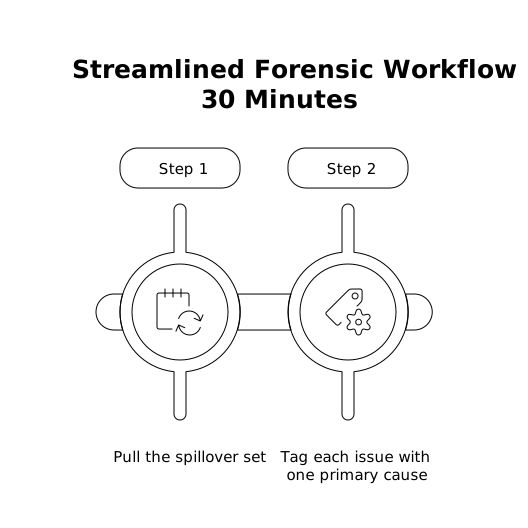
A lightweight forensic workflow you can run in 30 minutes
You don’t need a new ceremony. Run this at the end of every cycle (or at the start of the next planning session) and keep it consistent.
Step 1: Pull the spillover set
Collect the issues that rolled over plus any issues that were de-scoped late. Limit to a manageable sample: 10–15 items is usually enough to see the pattern.
Step 2: Tag each issue with one primary cause
Assign exactly one primary cause per issue, even if multiple factors contributed. Use the three buckets:
- Scope volatility
- Dependencies and waiting
- WIP overload
This constraint is important: it forces clarity. If everything is “a bit of everything,” nothing changes.
Step 3: Identify the “repeaters”
Find issues (or issue types) that spill over repeatedly: the same epic, the same class of bug, the same integration work. Repeaters are where intervention pays off fastest because you’re not solving an isolated event—you’re removing a recurring tax.
Step 4: Choose one fix you’ll enforce next cycle
Pick one change, not five. Examples:
- A scope-lock rule with explicit swaps.
- A dependency preflight checklist for cycle commitment.
- A WIP cap tied to review bandwidth.
Write the rule down in one sentence and apply it consistently for a full cycle. If you change multiple variables at once, you can’t learn what worked.
How to make spillover visible without adding overhead
The best spillover prevention is early detection. The following habits keep things observable while staying lightweight:
- Keep statuses meaningful. If “In Progress” hides blocked work, you’ll misread progress. Use a clear blocked signal so waiting is visible.
- Plan around finish, not starts. Encourage closing loops: reviews, QA, release steps. A fast workflow tool helps, but only if the team optimizes for completion.
- Make scope changes explicit. A mid-cycle change should create a visible tradeoff: swap, defer, or accept a spillover risk knowingly.
Tools like Linear tend to fit this style because they emphasize structured workflow, fast updates, and cycle-based planning without requiring heavy configuration. When the system makes changes easy to record, the forensics becomes a natural extension of how the team already works.
What “good” looks like after a few cycles
You’re not aiming for zero spillover. You’re aiming for fewer repeaters, less late-cycle thrash, and clearer reasons when rollover happens. If you run the same forensic method for three to four cycles, you should see:
- More stable cycle scope and fewer surprise expansions.
- Blocked work surfaced earlier, with dependency risks handled before commitment.
- Higher finish rates because WIP is constrained to match review and release capacity.
Most importantly, the team regains trust in the cycle. That trust is what enables tighter execution: planning becomes a practical tool rather than a recurring negotiation.
Vertical Video