
Why scope creep is easiest to spot inside a cycle
Scope creep rarely announces itself as a big decision. It shows up as “one more edge case,” “a quick refactor,” or “we should probably include X too.” In most teams, the early warning signs are present long before the release train derails—but they’re scattered across estimates, pull requests, reopened bugs, and the quiet shift from “shipping” to “polishing.”
The Cycle Confidence Score is a lightweight metric designed to make those signals visible while there’s still time to act. It doesn’t try to predict the future with precision. It gives you a consistent way to answer one practical question during every cycle: How likely are we to finish what we committed to, without heroics?
Teams using a structured execution workflow—especially in a fast system like linear.app—already have most of the inputs required. The goal is not to add reporting overhead, but to establish an early warning indicator that’s simple enough to check mid-cycle and credible enough to influence decisions.
What the Cycle Confidence Score measures
The Cycle Confidence Score (CCS) is a 0–100 score that reflects delivery risk for the current cycle based on a small set of observable factors. It’s intentionally “light”: you can compute it in minutes, and you can explain it in one breath.
Think of it as a composite of four risk signals that correlate strongly with scope creep and cycle slip:
- Commitment drift: how much work was added after the cycle started.
- Progress realism: whether work is moving through states at a pace consistent with the remaining time.
- Blocked load: how much of the cycle’s scope is waiting on external dependencies.
- Rework pressure: how often work reopens, expands, or returns to earlier stages.
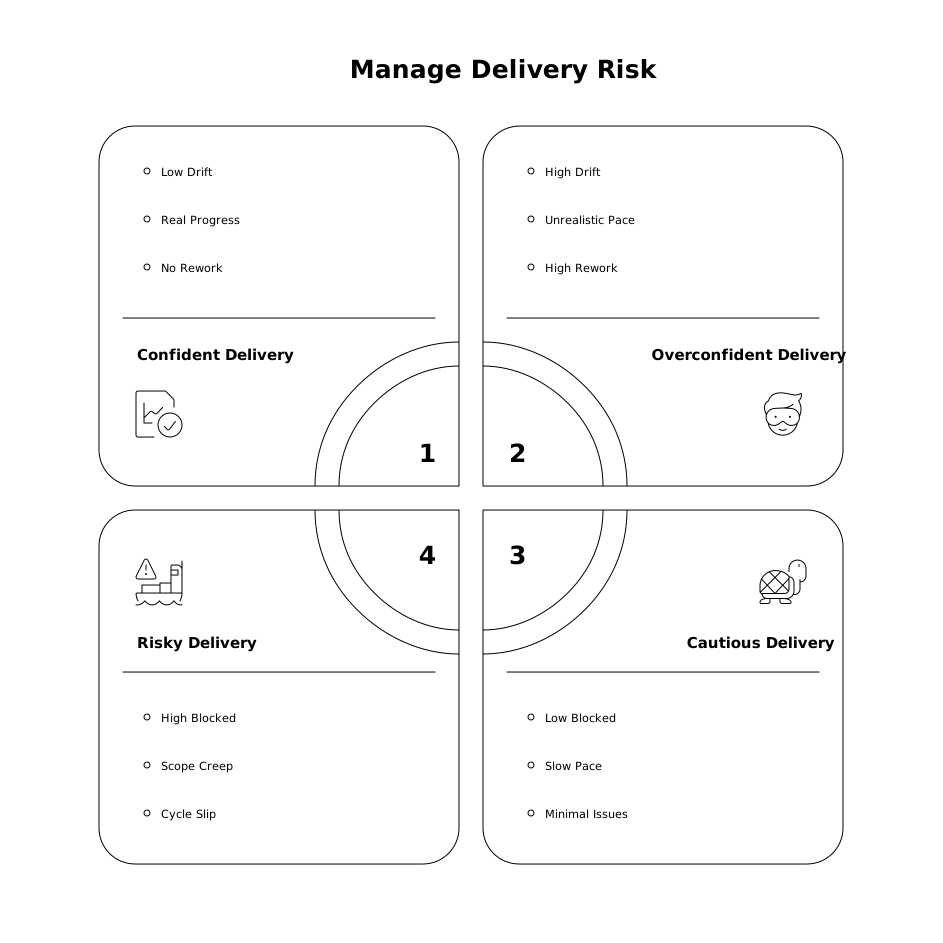
The score is not meant to judge individual performance. It’s a cycle-level indicator that helps product and engineering leaders protect the release train before the team is forced into late-cycle trade-offs.
A simple scoring model you can use immediately
You can implement the Cycle Confidence Score with a straightforward formula. Start with 100 and subtract weighted penalties. The weights below are deliberately conservative; you can adjust them over time to fit your team’s tolerance for risk.
1) Commitment drift penalty
Signal: work added after cycle start (new issues added to the cycle, or scope increases on existing issues).
Penalty: subtract 25 points if post-start additions exceed 15% of the original cycle scope; subtract 10 points if they exceed 5%.
Why it matters: cycles fail less because initial scope was too big, and more because the scope kept moving while the calendar stayed fixed. Tracking “added after start” keeps the conversation honest: are we delivering, or are we continuously renegotiating what “done” means?
2) Progress realism penalty
Signal: mismatch between time remaining and work remaining in “not started / in progress” states.
Penalty: subtract 20 points if you’re past the midpoint of the cycle and more than 60% of issues are still not in a “review/QA/done” neighborhood (define the states that represent “late-stage” for your workflow); subtract 10 if more than 50% remain early-stage.
Why it matters: teams often confuse activity with convergence. A cycle can look busy while still being far from shippable. This penalty is a check on flow: is work actually approaching completion, or accumulating in the middle?
3) Blocked load penalty
Signal: proportion of cycle scope marked blocked or waiting on dependencies (another team, vendor, infrastructure change, legal review, design handoff).
Penalty: subtract 15 points if blocked work exceeds 20% of the cycle; subtract 7 points if it exceeds 10%.
Why it matters: blocked work is a quiet multiplier. It compresses the time available for integration, testing, and stabilization, which is exactly when scope creep tends to sneak back in as “necessary fixes.”
4) Rework pressure penalty
Signal: issues reopened, sent back from review, or expanded materially (new acceptance criteria, additional sub-tasks) after being “in progress.”
Penalty: subtract 20 points if reopen/return events affect more than 15% of issues; subtract 10 points if more than 8% are affected.
Why it matters: rework is not inherently bad—it can reflect quality standards. But when it spikes inside a cycle, it signals either unclear scope, insufficient validation early, or hidden complexity. All three push teams toward late-cycle expansion.
How to interpret the score without turning it into theater
A score only helps if it triggers a specific, repeatable response. Treat the CCS as a simple classification:
- 80–100: Green — proceed; small adjustments only.
- 60–79: Yellow — tighten scope and protect integration time.
- 0–59: Red — renegotiate; remove work or change the release plan.
The important part is not the exact number. It’s the shared language. When someone proposes adding work mid-cycle, “What does that do to our confidence score?” is a less emotional question than “Why are you derailing the sprint?” It keeps the discussion in delivery terms.
Where the Cycle Confidence Score fits into your cycle rituals
The CCS works best when it’s checked at predictable points:
- Cycle kickoff: record baseline scope and expectations.
- Mid-cycle checkpoint: compute CCS and decide whether to freeze scope, cut items, or re-sequence.
- Two days before end: compute again to protect stabilization time and avoid “just one more thing.”
This rhythm is particularly effective in tools that make cycle boundaries explicit and keep state transitions clean. In Linear, for example, cycle planning, issue states, and clear ownership make it easier to compute the score without inventing new process. The value is in visibility, not bureaucracy.
Actions to take when the score drops
The CCS is only useful if it leads to a concrete intervention. When the score shifts from green to yellow (or yellow to red), prioritize actions that reduce scope volatility and protect finishing time:
- Freeze scope for the remainder of the cycle except true defects or critical unblocks.
- Split outcomes: ship the minimal coherent slice now; schedule the enhancements for the next cycle.
- Reconfirm acceptance criteria on the top items to reduce reopen risk.
- Escalate dependencies early: convert “blocked” into a named decision and an owner.
- Protect integration: stop starting new work late in the cycle if it threatens testing and release readiness.
Notice what’s absent: lengthy re-estimation. The point is to curb the drivers of creep (new scope, slow convergence, dependencies, rework) using fast decisions.
Keeping it lightweight and trustworthy over time
The first version of the Cycle Confidence Score should be easy enough that you’ll actually use it. After a few cycles, refine it based on what correlated with misses. Two practical adjustments help maintain credibility:
- Calibrate weights using your own history. If dependency risk is your biggest pattern, increase that penalty.
- Define states clearly so “progress realism” is meaningful. Ambiguous workflows create misleading signals.
When teams trust the score, they stop treating cycles as aspirational calendars and start treating them as execution containers. That is the real win: fewer surprise expansions, fewer end-of-cycle scrambles, and a release train that keeps its cadence without sacrificing quality.
Vertical Video