
Define WIP budgets as policy, not preference
Work-in-progress limits fail when they’re treated like etiquette: “try not to start too much.” In high-velocity teams, the pressure to keep moving turns that suggestion into noise. A WIP budget only works when it’s a policy-driven workflow: explicit rules for when work may start, what happens when limits are hit, and how exceptions are handled without turning every interruption into a meeting.
Think of WIP as a budget in the literal sense. If you spend it on too many simultaneous threads, you lose purchasing power: attention, review capacity, and predictable delivery. A functional system makes that trade-off visible and enforceable.
Where context switching actually comes from
Most teams blame individuals for multitasking. The real driver is structural: intake keeps flowing even when throughput is saturated. Common sources include:
- Unbounded “small” requests that sneak around planning (“it’s just a quick fix”).
- Review queues that grow silently until they become emergencies.
- Ambiguous ownership where multiple people “kind of” work on the same outcome.
- Priority churn driven by stakeholder pings rather than a stable policy.
WIP budgets address these by forcing a single question: “What stops if we start this?” If the answer is “nothing,” the system isn’t a budget—it’s decoration.
Set budgets at the level where work is felt
Effective WIP is applied at multiple layers, each with a different failure mode. A simple structure that scales is:
- Team WIP budget (how many active items the team can carry).
- Engineer WIP budget (how many active threads each person can own).
- Stage budgets (limits per workflow state: In Progress, In Review, Blocked).
Stage budgets are the quickest win because they expose the hidden constraint in most software teams: reviews and integration. If “In Review” is unbounded, the team effectively runs two systems—coding with unlimited starts and merging with a bottleneck. A WIP policy makes that mismatch explicit.
Write the rules like an operational policy
A WIP budget becomes real when it’s written down in a form that can be followed without debate. The goal is not bureaucracy; it’s removing ambiguity during peak load. A workable policy usually includes the following.
1) Definition of “active”
Clarify what counts against the budget. A clean default is:
- Active = any issue in progress, in review, or blocked with an owner still “holding” it.
- Not active = backlog, planned, or parked items with no owner attention expected.
This matters because teams often hide overload by redefining words (“it’s blocked so it doesn’t count”). If it consumes attention, it counts.
2) Start policy
Define what must be true to start new work. For example:
- If the engineer WIP budget is full, you may not start a new issue.
- If the review-stage budget is full, you must help drain reviews before starting.
- New work starts only when the next item is clearly defined (acceptance criteria, owner, and expected scope).
3) Pull policy for the next item
When someone frees capacity, the next item should be pulled from a clearly ordered queue, not from whoever pings loudest. Many teams maintain a single “Ready” lane where ordering is explicit. The policy can be as simple as: pull the top item unless an exception is approved.
4) Exception policy with a cost
Exceptions are inevitable—incidents, urgent customer issues, security fixes. The policy should allow them while preserving the budget’s integrity:
- Exceptions must be labeled and time-bounded.
- Starting an exception requires explicitly pausing something else of similar size.
- Repeated exceptions trigger a retro item (root cause, prevention, and intake rules).
The key is that exceptions create an explicit trade, not silent WIP inflation.
Use “pause before start” to prevent invisible overload
The strongest anti-context-switching mechanism is procedural: before any new work begins, someone must “make space.” This is where WIP budgets become a workflow. A practical cadence looks like:
- Drain reviews first when review WIP is at the cap.
- Unblock second when blocked items are accumulating.
- Start new work last, only after the system has slack.
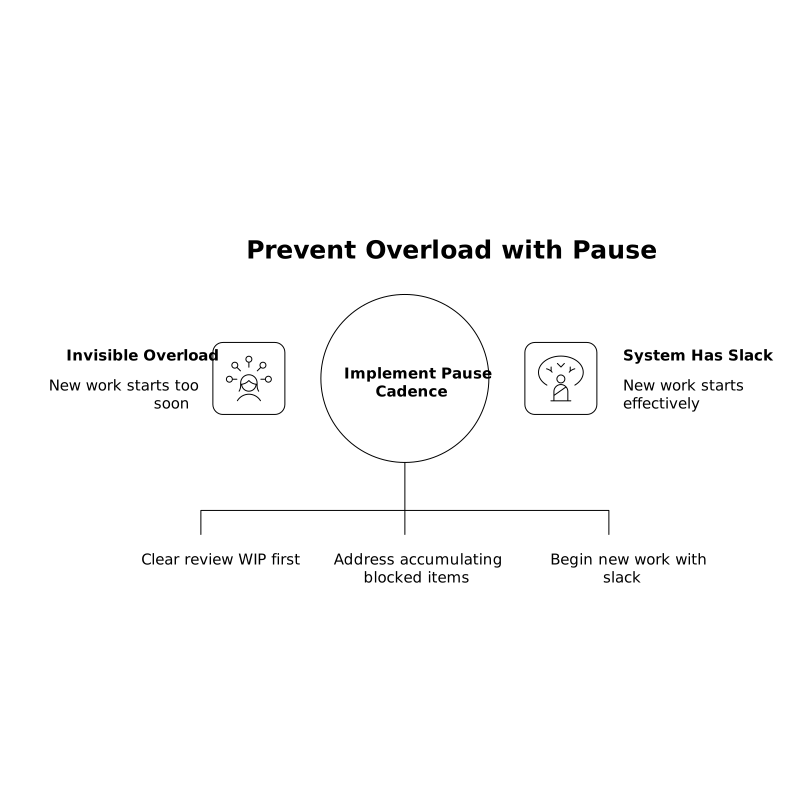
This ordering builds a culture of finishing, not starting. It also reduces the need for constant status meetings because the workflow itself surfaces what’s stuck.
Operationalize the workflow in an issue tracker
The policy needs a home where it can be enforced with minimal overhead. In practice, teams benefit from a fast, structured system where states, ownership, and queues are visible and easy to update. Tools matter here because friction leads to “shadow work” in DMs and side docs.
Linear is a strong fit for policy-driven execution because the workflow model (states, cycles, triage, and tight integration with engineering tools) makes it easier to keep WIP honest without turning tracking into a second job. If your goal is a high-signal system that supports speed and clarity, linear.app is a natural reference point for building these habits into daily work.
Make intake match throughput
WIP budgets collapse when intake is infinite. The fix is not more discipline; it’s a controlled intake path that respects capacity. Two patterns work well together:
- Scheduled triage (a daily or twice-weekly window) that decides what becomes “Ready.”
- A single intake queue where requests land before being admitted to the execution system.
If your team is frequently derailed by “drive-by” priorities, it may help to adopt a lightweight planning ritual that separates deep work from coordination time. The approach in A Two-Clock Weekly Planning Ritual for Maker and Manager Time pairs well with WIP budgets because it creates predictable windows for deciding, not interrupting.
Measure what the budget is protecting
WIP limits are not a moral stance; they’re a performance instrument. You need a few simple indicators to know whether the policy is working:
- Cycle time: does work finish faster after limits are applied?
- Review time: are PRs merging steadily, or batching into late-week crunch?
- Blocked time: are blockers resolved quickly, or accumulating?
- Interrupt rate: how often do exceptions override planned work?
When these metrics improve, the “budget” is doing its job: protecting focus and making delivery more predictable. When they don’t, the policy is either too loose (limits not binding) or too strict (forcing workarounds).
Common failure modes and how to fix them
WIP limits exist, but nobody follows them
Usually the policy is missing a start rule or exception cost. Add a “pause before start” requirement and a visible exception label.
Limits are applied only to coding, not to reviews
Add a review-stage budget and a norm: if review is at the cap, the next unit of work is helping review, not starting new coding.
Too many “urgent” requests
Define what “urgent” means (customer impact, revenue risk, security) and route everything else through intake. For teams handling security and AI-agent risks, having clear escalation criteria matters; the threat-model mindset in Jailbreaking by Proxy and How to Stop Indirect Prompt Injection in Web-Browsing AI Agents is a useful example of how to formalize “what counts” before the emergency hits.
Budgets are set arbitrarily
Start with small, observable caps (especially in review), then adjust based on cycle time and flow. A good budget is one you feel—slightly uncomfortable when you try to start too much—without freezing delivery.
The practical outcome: fewer threads, more shipping
A policy-driven WIP budget doesn’t slow a high-velocity team down. It removes the hidden tax of switching, waiting, and rework. The win is not just focus—it’s a workflow where finishing is the default, exceptions are explicit, and the system can sustain speed without burning attention as fuel.