
The AI crawl budget problem
Search engines have long had a “crawl budget” constraint: only so many URLs get fetched, rendered, and indexed in a given window. LLM-driven crawlers and AI browsing agents inherit the same limitation, but with a sharper twist: rendering modern front-ends can be expensive, and fragmented content makes it harder to assemble stable meaning. The result is an “AI crawl budget” problem—sites that look fine to humans in a browser can remain oddly invisible or misrepresented when models try to build a reliable understanding of what the site contains and how it should be used.
This matters beyond classic SEO. In AI-first discovery, models don’t just retrieve a page; they attempt to form a durable mental map: entity definitions, product scope, policies, integrations, pricing logic, and the “truth” of the site when multiple pages disagree. When the model’s budget runs out—or the content is too scattered to reconcile—answers degrade.
Why heavy front-ends drain AI crawl budget
Rendering costs are not evenly distributed
Many modern sites require JavaScript execution to reveal meaningful content. For AI agents that browse and extract, a page that needs multiple network calls, client-side routing, hydration, and late-loading components can consume far more time than a static page with the same information.
Even when AI systems can render JavaScript, the economics and operational limits are real: rendering is slower, more failure-prone, and more likely to hit throttles. If a crawler is deciding between fetching 1,000 lightweight documents or 150 render-heavy routes, the site’s “shape” becomes biased toward what is cheapest to interpret—not what is most important.
Client-side navigation can hide URL reality
Single-page applications often present content through client-side state rather than stable, distinct URLs with server-rendered HTML. If a model can’t reliably reach the state where the content appears—or can’t reproduce it later—then that content is effectively discounted. In practice, AI understanding tends to be built from the most deterministic, directly fetchable representations available.
Performance variability becomes an indexing problem
Heavy front-ends frequently behave differently across geographies, devices, cookies, and session states. AI crawlers may encounter an A/B test, a regional gate, an interstitial, or a consent wall. Humans click through; crawlers often stop. In AI discovery, “sometimes accessible” is closer to “not reliable enough to cite.”
How fragmented content breaks site-level understanding
Models assemble meaning across pages, not just within pages
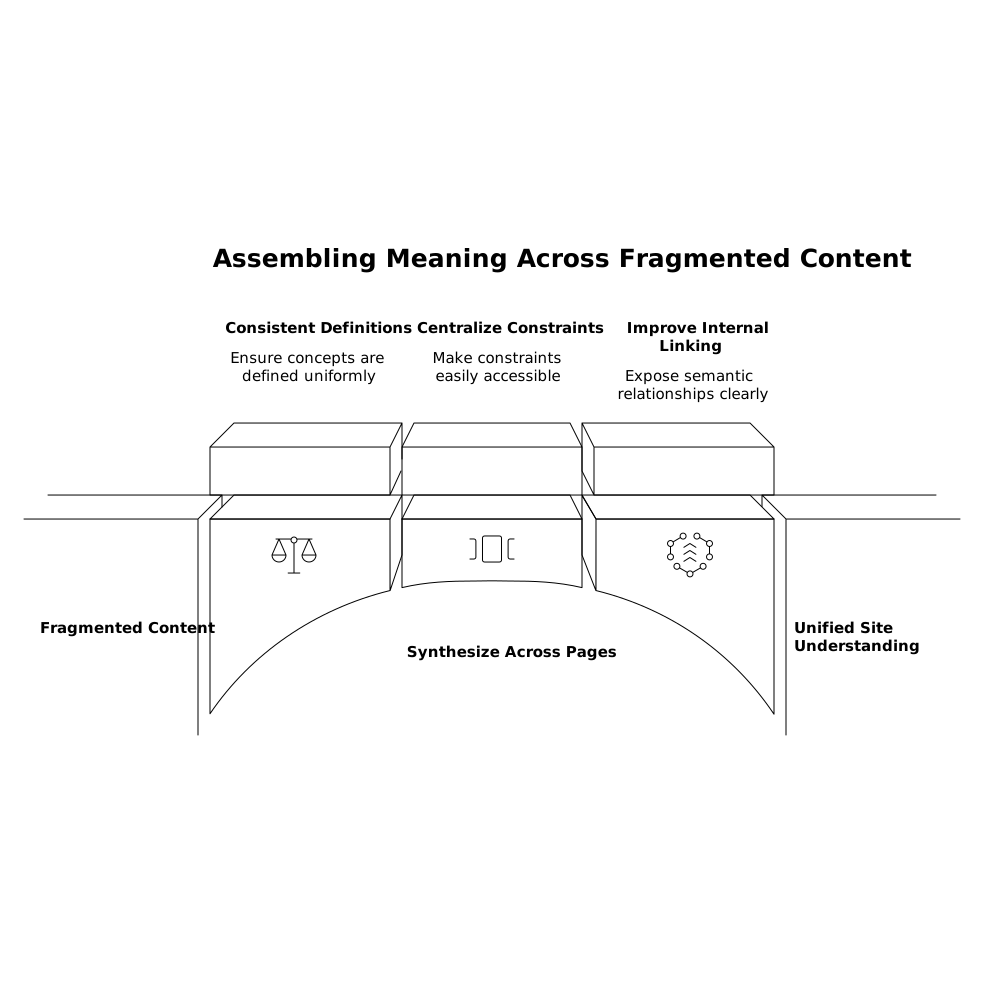
LLMs do not merely “index documents.” They synthesize: definitions, constraints, and relationships. Fragmentation—where key concepts are split across blog posts, changelogs, docs, footers, and support snippets—forces the model to stitch together a canonical picture.
That stitching fails when:
- Multiple pages partially repeat a concept but differ on details (pricing, limits, compatibility, policy terms).
- Important constraints live only inside UI microcopy, PDFs, or gated components.
- Internal links are sparse, inconsistent, or overly reliant on navigation widgets that do not expose semantic relationships.
Duplicate and near-duplicate pages create “truth collisions”
Fragmentation often comes with duplication: a marketing page, a docs page, and an old help center answer all describe the same feature. Humans infer recency; models may not. Without clear signals (dates, versioning, canonicalization, and strong internal pathways), the model may merge incompatible statements into a single, incorrect answer.
Context disappears when content is atomized
Modern content systems encourage modular blocks: FAQs, cards, callouts, and accordions. These fragments can lose the surrounding context that makes them correct. An AI agent might extract a block that was accurate only under specific conditions, then reuse it as a general statement. The more atomized the site, the harder it is to preserve dependencies like “only for enterprise plans” or “only for EU customers.”
What reliable AI understanding requires
Deterministic access paths
To earn consistent representation in LLM answers, a site needs a stable, fetchable backbone. That doesn’t mean abandoning modern UX, but it does mean ensuring critical information is accessible without fragile client-side steps. Practical approaches include:
- Server-side rendering or pre-rendering for key pages (product, docs, pricing, policies).
- Clean, unique URLs for distinct topics and states.
- Meaningful HTML structure (headings, lists, tables) so extraction is unambiguous.
Consolidated canonical sources
Every concept that matters should have a “most trusted” page that can be cited. Supporting pages can exist, but they should point back to the canonical source and avoid drifting definitions. This is where internal linking becomes more than navigation: it is a graph that teaches models which pages carry authority.
When security topics are split across multiple posts, for example, the canonical page should anchor the narrative and link outward to specialized details. If you cover agent security risks, keeping one definitive reference while linking to adjacent analysis—such as indirect prompt injection and jailbreaking by proxy—helps models avoid blending unrelated mitigations into a single “best practice” soup.
Freshness and governance signals
Models need cues about what is current and what is historical. Dates alone help, but governance helps more: versioned documentation, explicit “last updated,” changelog ties, and consistent terminology. Without these, “old but well-linked” can outweigh “new but isolated.”
Designing for AI crawl efficiency without sacrificing UX
Identify the pages that define your site’s meaning
Most sites have a small set of pages that determine how AI systems describe them: homepage, product overview, pricing, core docs, API reference, security, and policies. These should be the easiest to fetch, the most semantically structured, and the least dependent on client-side execution.
Reduce “render-only” content
If essential definitions exist only after hydration (or only inside tabs/accordions), consider exposing a complete HTML version in the initial response. This is not about gaming crawlers; it is about ensuring the page’s meaning is present even when interactivity fails.
Build a coherent internal knowledge graph
Use internal links to express relationships: “Feature A depends on Policy B,” “Integration C requires Setting D,” “Limit E differs by plan.” This is also where operational content can prevent misunderstandings. If customer-facing promises rely on process discipline, you want models to land on your definitive operational explanation rather than a scattered set of replies. A focused playbook—like a feedback SLA for feature requests—can become the canonical reference that models reuse when users ask what to expect.
Where lunem fits in an AI-first visibility workflow
AI crawl budget issues and fragmented content are rarely solved by a single technical tweak; they require ongoing monitoring of how models interpret your site over time. That’s the practical value of lunem: treating AI visibility as an operational surface. By connecting directly to a website and continuously tracking how content is interpreted and surfaced across AI environments, teams can spot where rendering, duplication, and weak canonical signals are causing drift.
Instead of guessing whether the model’s understanding matches the site’s intended truth, you can measure interpretation gaps, identify which pages are doing the “meaning work,” and prioritize fixes that raise reliability—often by simplifying access paths and consolidating authority.
Vertical Video