
Why visual no-code UIs still need testable contracts
No-code frontends are fast because they turn UI work into configuration: data sources, states, conditions, and workflows. The downside is that many teams treat those configurations as “untestable” until the app hits staging—when backend contracts, auth edge cases, and payload changes surface as broken screens.
A practical way out is to treat the UI as a consumer of APIs with explicit contracts, then enforce those contracts with a mock server and CI gatekeepers. The goal is not to recreate end-to-end testing in the browser. It’s to ensure the UI never drifts from the API behaviors it depends on, even when the backend evolves.
The pattern in one sentence
Define consumer contracts for the UI, generate realistic mock responses from those contracts, run automated checks in CI, and block merges when the UI requests or assumptions change without an updated contract.
Contract testing, adapted for no-code frontends
What counts as a contract for a visual UI
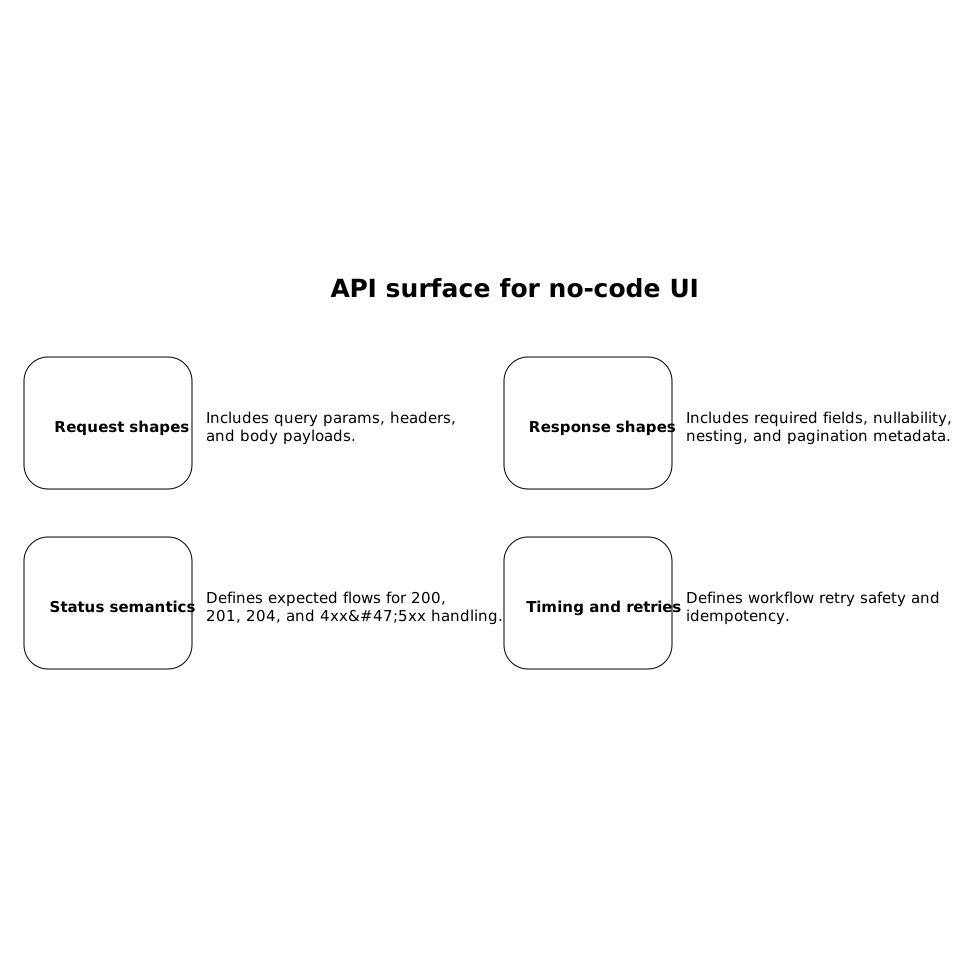
In a no-code app, the “API surface” the UI relies on typically includes:
- Request shapes: query params, headers (especially auth), body payloads.
- Response shapes: required fields, nullability, nesting, pagination metadata.
- Status semantics: which flows expect 200 vs 201 vs 204, and how 4xx/5xx are handled.
- Timing and retries: whether a workflow can safely retry, and what idempotency looks like.
A contract should be explicit about the UI expectations that would break rendering or logic if they changed. For example, “user.role is always present,” or “pagination returns items and nextCursor.”
Why this works especially well for no-code
No-code tools often encourage direct binding: a component expects a field to exist, a condition assumes a boolean, a workflow step assumes a 201 response. Contract tests catch these assumptions before they reach staging by making them visible and enforceable.
Step 1: Define contracts as consumer-owned artifacts
Start with the UI as the contract owner. That sounds backwards if you’re used to backend-first specs, but it’s the fastest way to make the contract reflect the real breakpoints in the UI.
Practical contract formats include OpenAPI (when you can express the behavior), JSON Schema for payloads, or consumer-driven contract tools that support interactions. The key is that contracts are versioned with the frontend and reviewed like code.
Keep contracts small and focused:
- One contract file per domain area (auth, billing, profiles, search).
- Include examples for edge cases the UI must handle (empty lists, null optional fields, permission denials).
- Document any derived assumptions (e.g., “if
status=archived, hide edit actions”).
Step 2: Stand up a mock server that speaks the contract
The mock server is the bridge between “contract as a document” and “contract as something you can test against.” It should be able to respond with valid payloads and status codes that match the contract, and ideally simulate multiple scenarios.
A useful setup is to generate:
- A “happy path” dataset for each endpoint.
- Permission errors (401/403) with the exact error schema the UI expects.
- Validation errors (400/422) with field-level details for form UX.
- Empty and partial states to validate conditional rendering.
For teams building on WeWeb, this fits naturally: the UI can bind to a stable mock base URL locally and in CI, then switch to real environments via variables. When you’re generating and refining a production-grade app visually, being able to toggle between mock and real services is what keeps iteration speed without sacrificing reliability.
WeWeb’s approach—AI-assisted generation plus a no-code editor, with the ability to export a standard Vue.js SPA—also makes the “contract-first” discipline portable. If you later self-host or move pipelines, your test strategy doesn’t depend on a proprietary runtime. Reference: weweb.io.
Step 3: Make CI the gatekeeper, not the staging environment
The contract pattern pays off when CI becomes the first place breakages are detected. A simple gate can be:
- Spin up the mock server for the contract version in the PR.
- Run a build of the frontend (or export) and execute automated checks.
- Validate that API calls made by the UI match the contract.
- Fail the pipeline if the UI requests new fields, different endpoints, or changed semantics without updating the contract.
Depending on your stack, the checks can be implemented as:
- API interaction tests that assert the UI’s requests (method/path/headers/body) match the expected contract.
- Schema validation tests that ensure responses consumed by UI bindings conform to the contract schema.
- Snapshot-like checks for key computed states (e.g., “empty results shows empty state component”).
This is also where you add guardrails for retries and duplicated submissions. If your UI uses workflows that may re-run on network hiccups, pair the contract with idempotency behavior so you can test it early. If you need a deeper reliability model, the mechanics of idempotency keys and retry-safe workflows are explored in reliable event-driven no-code frontends.
What to test specifically in visual UIs
Field presence, nullability, and display logic
Most no-code breakages are “binding errors”: the UI expects a field that disappears, changes type, or becomes null. Encode those expectations directly:
- Required fields used in headings, avatars, or navigation labels.
- Optional fields that must not crash formatting logic.
- Enums used in conditions (e.g., status chips, role-based sections).
Auth and permission boundaries
Contracts should include what the UI does on 401 vs 403, and what shape error bodies take. Many teams “handle errors” visually but don’t standardize error payloads, leading to inconsistent UX. Put the payload schema in the contract so the mock server can generate it and CI can enforce it.
Pagination, filtering, and search semantics
Pagination is a frequent source of drift: cursor names change, list envelopes shift, total counts appear/disappear. Treat list endpoints as high-priority contracts. If the UI uses “load more,” specify cursor rules; if it uses page numbers, specify count and page metadata.
Workflow side effects and idempotency
When a visual workflow creates a record, charges a card, or triggers an external automation, the UI needs predictable outcomes. Write contracts that distinguish “created” vs “already exists” and simulate retry conditions. This is one of the places where contract testing prevents costly production incidents that traditional UI snapshots won’t catch.
How to introduce this without slowing teams down
A lightweight rollout plan:
- Start with the top 5 endpoints the UI can’t function without.
- Add one edge case scenario per endpoint (empty, unauthorized, validation error).
- Turn on CI enforcement only for changed contracts at first, then expand coverage.
- Use contract diffs as a review artifact in PRs: “UI now depends on
billing.planTier.”
If your team is already mixing no-code with code (for example, React or custom components around backend services), contract tests can be the common language across both. A more backend-integrated view of this approach is outlined in closing the AI builder to production testing gap with contract tests.
The practical payoff
This pattern shifts UI reliability from late-stage staging surprises to early, reviewable changes. Mock servers give designers and builders stable data to work with. Contracts give backend teams a clear target. CI gatekeepers ensure neither side changes critical behavior silently.
For teams shipping quickly with a visual platform, the result is a no-code frontend that behaves like a disciplined software client: explicit dependencies, testable assumptions, and safer iteration—without giving up the speed that made no-code attractive in the first place.