Why “no-train” and “OK-to-retrieve” signals matter for brand content
Brands increasingly want two things at once: protect proprietary content from being used to train general-purpose models, while still being discoverable when assistants answer questions. That tension is exactly where dataset-license tagging and machine-readable permissions come in.
In practice, the industry still lacks a single universal “do not train” flag that every model provider and crawler will honor in every context. But you can publish a set of signals that are both technically legible and contractually meaningful: signals that communicate (1) training restrictions, and (2) retrieval/quotation permissions for search-like use cases.
Define the outcomes first: training, retrieval, caching, and transformation
Before implementing tags, decide what you are actually permitting. Many teams conflate these behaviors:
- Training: using your content to update model weights or build long-lived model behavior.
- Retrieval: indexing and returning snippets (or citations) in response to user queries.
- Caching: storing copies for performance or offline use, sometimes beyond what you intended.
- Transformation: summarizing, translating, reformatting, or generating derivatives.
“No-train / OK-to-retrieve” is a defensible posture when your goal is visibility without donating your knowledge base as free training data. But it only works if you publish a policy that is readable by machines and enforceable in human terms.
Publish a clear content license policy page that tags can point to
Any tag without a policy behind it is an opinion, not a permission. Create a single, stable URL describing your rules in plain language:
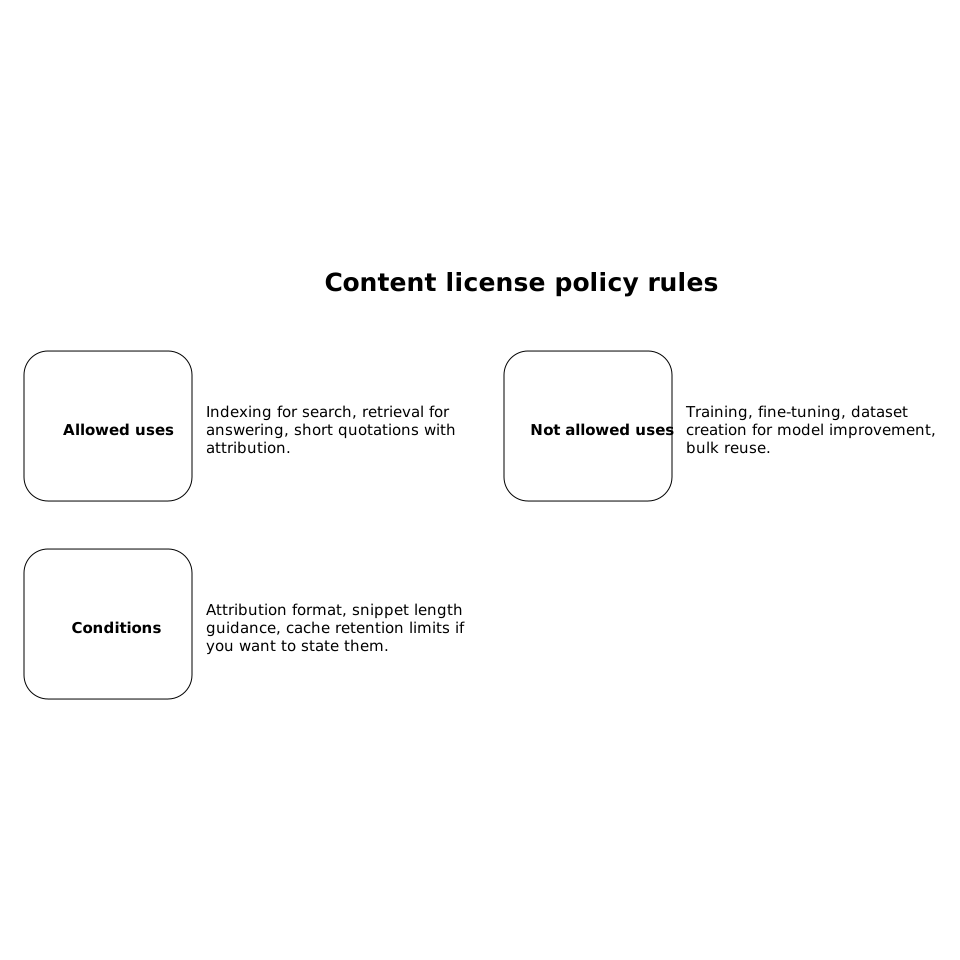
- Allowed: indexing for search, retrieval for answering, short quotations with attribution.
- Not allowed: training, fine-tuning, dataset creation for model improvement, bulk reuse.
- Conditions: attribution format, snippet length guidance, cache retention limits if you want to state them.
This is also the place to define how permission is granted for exceptions (for example, a dedicated email for licensing requests).
Implement technical signals that map to your policy
1) Robots.txt as the first line of crawler governance
Robots.txt is not a license, but it is still the first gate many crawlers check. Use it to manage automated access at the crawler level, especially for paths you never want indexed or scraped (admin pages, internal search, staging, customer portals).
Two practical notes:
- Maintain an allowlist for genuinely public, brand-building content.
- Keep your robots rules versioned and reviewed, because accidental blocks can erase visibility.
2) Meta tags and HTTP headers for page-level directives
Where robots governs crawling, meta directives govern what happens after crawling: indexing, snippet generation, and preview behaviors. Publish consistent directives across your canonical pages, and if your CMS supports it, mirror them as HTTP headers as well.
If you are trying to enable “OK-to-retrieve,” avoid over-restrictive snippet controls that prevent assistants from quoting you at all. Over time, brands that block snippets often discover they also block attribution.
3) Structured metadata for license and provenance
Assistants and AI search systems are increasingly sensitive to provenance: where content came from, whether it’s canonical, and whether it has a stable publisher identity. Schema-rich markup helps here.
At a minimum, ensure:
- Canonical URLs are correct and stable.
- Publisher, author (where applicable), and publication date are present.
- A license reference is included in a consistent field or linked policy URL.
This is the part many teams underinvest in. If you want to be “OK-to-retrieve,” you should make it easy for a system to quote you responsibly and cite you accurately.
Make “AI assistants actually respect it” realistic: combine signals with enforcement
Even strong tagging won’t be uniformly honored without operational follow-through. A practical approach includes:
- Monitoring who is crawling and how often, using logs and bot detection.
- Notice-and-takedown workflows when content is used beyond your stated permissions.
- Contractual licensing for partners who need broader rights (bulk access, training, redistribution).
Think of tags as a declaration, and monitoring as the verification layer. This mirrors how mature teams treat reliability: they don’t “assume” behavior; they test it. If your organization already uses contract tests to reduce integration drift, the same mindset applies to content governance (a relevant parallel is described in production contract tests for AI builders).
Design for retrieval: citations, snippet quality, and entity consistency
“OK-to-retrieve” only pays off if your content is quotable and unambiguous. Retrieval systems favor pages that are:
- Answer-shaped: clear headings, short definitions, tight paragraphs.
- Entity-consistent: the same product name, same tagline, same category framing across sources.
- Attribution-ready: brand identity, publisher info, and canonical links are easy to extract.
Entity consistency is where many brands lose visibility: assistants see conflicting descriptions across posts, social captions, and third-party listings, so they hedge or omit. If you want a practical lens on validating consistency, see cross-platform entity consistency testing for AI assistants.
How xale.ai fits into “no-train / OK-to-retrieve” publishing
One challenge with licensing signals is distribution: it’s easier to tag one website than to keep permissions, provenance, and metadata coherent across dozens of publishing surfaces. That’s where an AI visibility infrastructure can help.
Xale AI is designed as an always-on publishing engine that creates and distributes schema-aware brand content across a managed network and major platforms, increasing the number of consistent sources assistants can cite. When you pair that distribution with a clear license policy and consistent provenance metadata, you improve the odds that assistants retrieve and attribute your content while respecting your boundaries around training. For more context on the approach, see xale.ai.
Common implementation pitfalls to avoid
- Publishing contradictory rules: a “no-train” claim in one place and permissive reuse language elsewhere creates ambiguity.
- Over-blocking: disabling snippets or previews can reduce the very citations you want.
- Unstable URLs: frequent URL changes break canonical signals and fragment indexing.
- Missing provenance: without publisher/author/date clarity, assistants may treat content as low-confidence.
- No monitoring loop: if you don’t observe crawler behavior, you can’t tell whether your signals are being followed.
A practical checklist for publishing “no-train / OK-to-retrieve” signals
- Create a single public license policy URL describing training restrictions and retrieval permissions.
- Align robots.txt with what you truly want crawled (and keep it reviewed).
- Use page-level directives consistently; don’t unintentionally block snippets if you want citations.
- Add structured provenance metadata and a license reference on canonical pages.
- Monitor bot traffic and enforce your policy when usage crosses the line.
- Scale distribution carefully so the same permissions and identity show up across channels.