
Why “silent deal killers” matter more than loud objections
Most pipeline risk doesn’t arrive as an explicit “we’re going with another vendor.” It shows up as a series of small, easy-to-miss signals inside call transcripts: vague ownership, fuzzy next steps, repeated “circling back,” missing success criteria, or a buyer who sounds engaged but never commits to a decision process. These are “silent deal killers”—patterns that rarely trigger a rep’s alarm in the moment, yet reliably predict slippage, discount pressure, or no-decision outcomes.
Transcripts make these signals measurable. When every conversation is searchable, timestamped, and comparable across deals, you can move from intuition (“this feels off”) to early-warning indicators that help you intervene while the deal is still recoverable.
From call notes to risk signals: what transcripts enable
Manual notes tend to compress ambiguity into a confident narrative. Transcripts preserve the exact language: who said what, how often topics came up, and whether the buyer actually agreed to next steps or simply acknowledged them. This is where an AI meeting partner becomes a practical analytics layer—capturing full context without forcing sellers to choose between being present and taking notes.
Tools like Fathom turn calls into searchable transcripts, immediate summaries, and action items right after the meeting ends. That matters for risk detection because the “signal” is often a sentence fragment or repeated phrase that disappears in a recap.
The silent deal killers you can spot in transcripts
1) No real decision process
Listen for buyers describing activity instead of a process: “We’re still looking,” “We’ll review internally,” “We’re socializing options.” In transcripts, this often coincides with missing specifics: no timeline, no meeting cadence, no evaluation criteria, no procurement steps, and no named approver. If the rep asks “What’s the next step?” and the answer stays abstract, the deal is at risk even if the call felt positive.
2) Unclear ownership and “someone else” language
Risk shows up when ownership is diffused: “I’ll check with finance,” “We’ll see what the team thinks,” “Someone from security will weigh in.” These statements aren’t bad by themselves—cross-functional input is normal—but they become deal killers when no one is accountable for moving the evaluation forward. In transcripts, watch for an absence of named stakeholders or repeated references to unnamed groups.
3) Next steps that aren’t mutual commitments
A classic transcript pattern is the rep proposing a next step and the buyer responding with non-committal agreement: “Sounds good,” “Let’s do that,” “Yeah, send it over.” If there’s no calendar action, no deadline, and no explicit owner, you don’t have a next step—you have a hope. The risk is highest when this repeats across multiple calls: the deal stays “active” while momentum quietly dies.
4) Success criteria that never gets defined
Many deals stall because “value” remains generic. If transcripts show repeated talk about features, but little about outcomes (what improves, by how much, by when), you’re vulnerable to comparison shopping and price pressure. Look for missing numbers, missing baselines, and missing definitions of what “better” means. Even in SMB deals, a buyer should be able to describe the before/after state.
5) Soft objections that get acknowledged but not resolved
Silent objections often sound polite: “We’re concerned about change management,” “I’m not sure adoption will be easy,” “We’ve tried something similar.” The risk isn’t that the concern exists—it’s that it’s never converted into a plan (pilot, enablement, proof points, stakeholder buy-in). In transcripts, these concerns can be identified by being raised, lightly answered, and then never referenced again—until the deal slips.
6) Competitive evaluation without differentiation
Buyers will say they’re “looking at a few options.” The transcript signal to watch is whether your differentiators are confirmed in the buyer’s words. If differentiation only appears in the rep’s monologue—and the buyer never repeats it, tests it, or ties it to their requirements—the deal is drifting toward a generic bake-off where the cheapest or most familiar choice wins.
How to build an early-warning system using transcripts
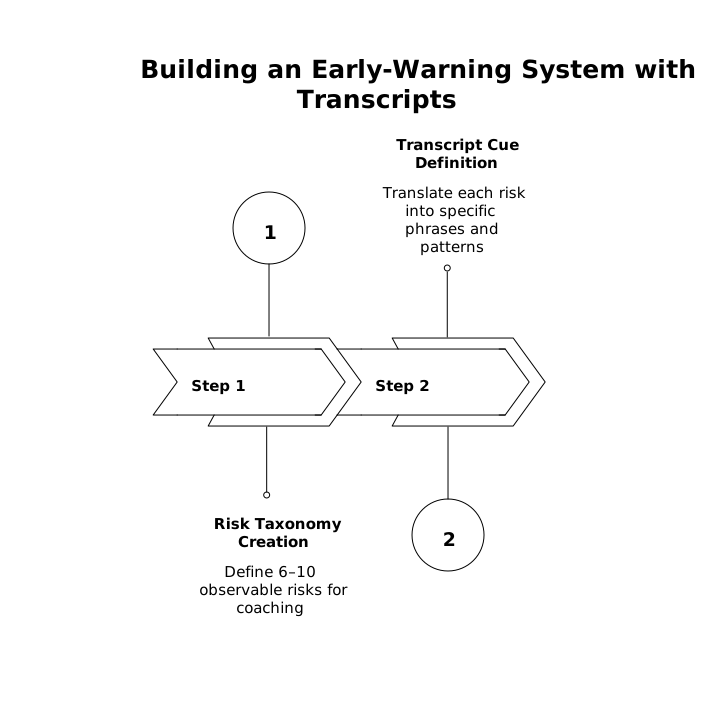
Step 1: Create a risk taxonomy you can actually enforce
Start with 6–10 risks that are observable in language and behavior. Examples: “no mutual next step,” “no economic buyer identified,” “timeline is aspirational,” “value metric absent,” “security/procurement unknown,” “pilot criteria not defined.” Keep it small enough that managers can coach against it weekly.
Step 2: Turn each risk into transcript cues
For each risk, define the phrases and patterns you expect to see. For instance:
- No decision process: “we’ll review,” “we’re evaluating,” “we’ll get back to you” without dates or owners.
- No mutual next step: “send me info,” “follow up next week,” “let’s reconnect” without a scheduled meeting.
- Value not anchored: heavy feature talk, little “current state,” “target state,” or measurable outcomes.
These cues can be used in coaching, enablement, and deal reviews. They also make it easier to standardize what “risk” means across the team.
Step 3: Operationalize review without adding rep burden
Early-warning systems fail when they require extra manual work. The practical workflow is simple: capture the call, generate a clean summary, and make the transcript easy to search so managers and sellers can validate what was actually agreed.
Because Fathom produces summaries and action items immediately after meetings, teams can spot missing commitments while the conversation is still fresh, and fix them in the follow-up email or the next call. Searchable transcripts also help a manager jump directly to the moment a buyer expressed concern, rather than relying on secondhand recollection.
Step 4: Use keyword alerts and “trend” questions
Some risks are detectable through recurring terms: “legal,” “security,” “budget,” “freeze,” “reorg,” “pilot,” “migration.” A lightweight discipline is to review where these terms appear and what happened next. Another approach is to ask consistent questions across transcripts, such as:
- Did the buyer state a business problem in their own words?
- Did anyone describe how a decision will be made?
- Is there a calendarized next step with mutual ownership?
When “Ask Fathom” style querying is applied to past conversations, teams can surface patterns across deals, not just within a single account—useful for diagnosing systemic pipeline risk (for example, a segment where procurement surprises are common).
Step 5: Close the loop in CRM with evidence
Pipeline hygiene improves when CRM fields reflect reality, not optimism. After reviewing transcripts, update the deal with concrete facts: named stakeholders, confirmed timeline, defined success criteria, and agreed next steps. The goal isn’t more admin—it’s fewer surprises. Integrations that sync meeting outputs into tools like Salesforce or HubSpot make it easier to keep records aligned with what the buyer actually said.
What “good” looks like in transcript-based deal health
Healthy deals have a distinctive transcript signature: buyers name the problem and desired outcome, stakeholders are identified, the evaluation process is described, objections become action plans, and next steps end with a scheduled meeting and clear owners. When those elements are missing, it’s rarely a mystery—transcripts show it. The advantage is timing: you can address risk while the deal is still in motion, rather than after it quietly slips a quarter.