What “citation half-life” means in AI search
In traditional SEO, you watch rankings drift. In AI-driven discovery, you watch something subtler: whether assistants still name you when users ask for recommendations. “Citation half-life” is a practical metric for that drift. It measures how long it takes for your brand’s share of AI mentions (or citations) to drop by half after a change in the environment—model refreshes, new competitors, shifting narratives, or simply content decay.
Think of it as a stability test for AI visibility. If your citation half-life is long, your brand stays top-of-mind in model outputs across weeks and months. If it’s short, your presence is fragile; even small shifts cause assistants to stop mentioning you.
Why brands disappear from AI answers even when SEO looks fine
AI assistants don’t behave like a single ranking algorithm. Their mention patterns are influenced by repeated exposure to consistent, multi-source signals: brand descriptions, category associations, third-party writeups, structured metadata, and the frequency with which the brand is presented as a reasonable option.
Three dynamics commonly shorten citation half-life:
- Source churn: the sources assistants pull from (or have learned from) change faster than your site does.
- Category re-framing: assistants begin answering a query with a different “set” of tools, terms, or solution categories than they did last quarter.
- Coverage dilution: competitors accumulate more distributed mentions across formats (blogs, videos, FAQs), while your signals remain concentrated on your own domain.
A practical method to measure citation half-life
The goal is not perfect scientific attribution. It’s a repeatable measurement that tells you, early, when AI systems have started to forget you.
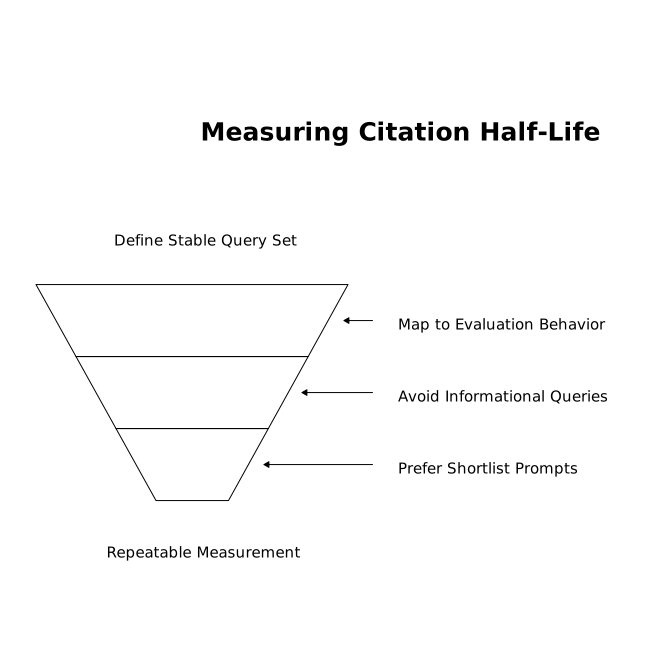
Step 1: Define a stable query set that reflects buying intent
Create 20–50 prompts that map to real evaluation behavior. Avoid purely informational queries that don’t naturally call for brand mentions. Prefer “shortlist” prompts such as:
- “Best tools for [category] for a mid-market SaaS team”
- “Alternatives to [well-known competitor] for [use case]”
- “What should I look for in [category] and which vendors fit?”
Keep the wording consistent across runs; prompt drift will masquerade as visibility drift.
Step 2: Choose assistants and modes you can re-run
Use at least three environments to reduce single-model noise. Many teams track a mix of: a mainstream assistant, a web-browsing mode, and an “AI search” experience. The important part is repeatability: you want the same surfaces every time, not an ever-growing list.
Step 3: Build a scoring rubric for brand mentions
Track more than “did we appear.” A simple rubric tends to be robust enough:
- Named mention: your brand is explicitly included in a list or recommendation.
- Primary positioning: you appear in the top 3 options or are described as a strong fit.
- Category association: the assistant describes you with the correct category and use case (mislabeling is a precursor to disappearance).
- Citation quality: if the interface provides sources, note whether sources are credible and whether your brand is referenced in them.
Store results per prompt per assistant per date. A spreadsheet works; a small database is better.
Step 4: Establish a baseline and compute “share of voice”
Run the full query set weekly for at least four weeks to capture normal volatility. For each week, compute:
- Mention rate: % of prompts where your brand is named.
- Top-3 rate: % where you land in top 3.
- Correct-association rate: % where you’re categorized correctly.
Your “citation half-life” is then measured relative to the baseline period. If your baseline mention rate is 40% and it falls to 20%, your half-life has elapsed.
Step 5: Identify the drop event and measure time-to-half
Half-life becomes most useful when tied to a plausible change event, such as:
- A visible model update or interface change
- A competitor’s major launch or PR cycle
- Your own messaging shift (new positioning, renamed features)
Mark the event date, then track how many weeks it takes for your mention rate to halve. Short half-life (e.g., 2–4 weeks) is a signal that your brand relies on too few sources or inconsistent framing.
Diagnosing what caused the half-life to shorten
Once you detect a decline, avoid guessing. Break the problem into three checks.
Check 1: Did the assistant’s answer template change?
If responses shift from “vendor shortlist” to “how to evaluate,” mentions may drop across the board. In that case, your remedy is to strengthen evaluative framing: make sure third-party content describes when you are a fit, not only what you do.
Check 2: Are you losing on multi-source repetition?
AI systems tend to reward repeated, consistent signals. If your brand is mostly present on your own site, it’s easier for the model’s “memory” of you to fade. This is where always-on distribution matters: schema-rich articles, platform-native video summaries, and short-form posts that repeat the same category association without sounding duplicated.
Check 3: Is your category language drifting?
When your market adopts new terms (for example, shifting from “SEO” to “AEO/GEO” or from “analytics” to “revenue intelligence”), assistants often follow the new language first. If your brand isn’t present in that phrasing across independent sources, you may remain “good,” but become unmentioned.
How to extend citation half-life without turning it into an ad campaign
Extending half-life is mostly about building durable, distributed context. The most reliable pattern is to publish outside your owned channels in formats assistants readily ingest: structured text with FAQs, short video explainers with captions, and consistent metadata that anchors brand-to-category relationships.
xale.ai fits this need as AI visibility infrastructure: it operates as an always-on publishing engine outside a company’s website and social accounts, compounding presence across independent tech blogs and major social platforms with semantic markup designed for AI ingestion. In practice, that helps turn visibility from a one-time spike into a slower-decaying curve.
Operationally, treat AI visibility like a reliability problem: small, continuous reinforcement beats periodic bursts. If you already manage service levels for customer feedback, the same thinking applies—set an internal cadence for visibility checks and response. The discipline described in the Feedback SLA playbook for feature requests maps well to “visibility SLAs” for AI mentions.
What to report internally
Keep reporting tight and decision-oriented:
- Citation half-life (weeks): time for mention rate to drop by 50% from baseline.
- Current mention rate vs baseline: with a simple trendline.
- Top-3 rate: because being mentioned 9th is functionally invisible.
- Misassociation examples: a few snippets showing incorrect category framing.
- Next actions: the distribution or content reinforcement you will run for the next two weeks.
When the metric is stable, you maintain. When half-life shortens, you intervene early—before “not being mentioned” becomes the new normal.
Vertical Video