
Why egress control is the quiet failure mode in modern workloads
Serverless functions and AI workloads are designed to move fast: they pull data from storage, call third-party APIs, enrich responses, and stream results to users. That same flexibility creates an uncomfortable truth: if a workload can reach the Internet, it can exfiltrate data—intentionally or by accident—through ordinary outbound DNS lookups and HTTP requests.
Traditional perimeter controls help, but they often assume long-lived servers, fixed IP ranges, and predictable network paths. Serverless and agentic AI break those assumptions. The practical control surface shifts “outward,” toward where requests leave your environment. That’s where edge-enforced DNS and HTTP policies become useful: they constrain where code can talk, how it can talk, and what it is allowed to send.
Common exfiltration paths in serverless and AI systems
DNS as the first step of most outbound traffic
Before most outbound connections happen, a DNS query resolves a hostname. Attackers (or compromised dependencies) can abuse DNS directly—encoding secrets into subdomains—or use DNS to locate an egress endpoint that looks innocuous. If you don’t control outbound DNS, you may not even see the “directory service” that makes exfiltration possible.
HTTP and HTTPS as the most convenient data tunnel
HTTP is the default interface for everything: analytics beacons, webhook retries, model providers, “observability” SDKs, and supply-chain callbacks. Data can leak in query parameters, headers, POST bodies, multipart uploads, or even as URL paths to attacker-controlled hosts. HTTPS hides content from the network, which is great for privacy—but it also hides accidental leakage unless you apply controls where policies can see intent and destination.
AI-specific risk: tools, browsing, and indirect prompt injection
Agent frameworks often include tools for browsing, calling APIs, or retrieving documents. A malicious web page or document can steer an agent into calling attacker endpoints. If you’re designing defenses against prompt-driven misuse, pair egress controls with governance for tool use. For a deeper look at this threat class, see Jailbreaking by Proxy and How to Stop Indirect Prompt Injection in Web-Browsing AI Agents.
Why “allow outbound” is not a policy
Many teams treat outbound traffic as implicitly safe because inbound traffic is already protected by WAF rules, authentication, and rate limiting. But egress is where secrets leave: API keys, tokens, customer data, embeddings, internal URLs, and proprietary prompts. “We’ll detect it later in logs” is also not a policy—by the time you detect exfiltration, the data is already gone.
Egress control is fundamentally about reducing reachable destinations and minimizing the data that can be transmitted. DNS and HTTP policy at the edge gives you two powerful levers: destination control (where can we connect?) and behavior control (what types of requests are allowed?).
DNS policy at the edge as a destination firewall
Start with an allowlist model
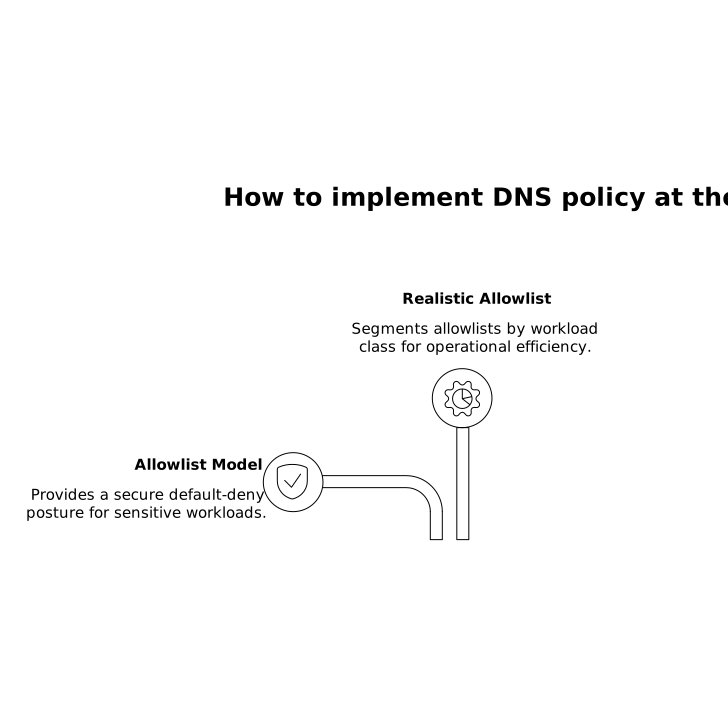
For sensitive workloads (AI agents with browsing, serverless functions with secrets, automation jobs with customer data), a default-deny outbound DNS stance is the cleanest posture. Maintain an allowlist of domains (and, where necessary, subdomains) that the workload is permitted to resolve. Everything else fails fast at the DNS layer.
Make the allowlist operationally realistic
Allowlists fail when they’re brittle. A good approach is to segment allowlists by workload class:
- Core dependencies: model providers, auth endpoints, storage backends.
- Observability: approved metrics and logging destinations only.
- Third-party APIs: explicit vendors tied to a business function.
- Update and package registries: ideally removed from runtime entirely; if required, tightly constrained.
Keep ownership clear: platform/security defines the baseline; service owners request additions with a ticket and an expiry. Expiring entries matter—many allowlists become permanent by neglect.
Block known bad patterns and reduce ambiguity
Even with allowlists, add guardrails: block newly registered domains if your risk tolerance demands it, reject suspiciously long labels (common in DNS tunneling), and refuse resolution for categories you never need (ad tech, crypto mining pools, paste sites). The goal is not perfect categorization; it’s shrinking the search space for attackers and mistakes.
HTTP policy at the edge as behavioral control
Constrain by hostname, method, and path
HTTP policy becomes meaningful when it’s not just “allow https to these domains.” For each approved domain, define what the workload is allowed to do:
- Methods: allow GET for retrieval endpoints, restrict POST/PUT unless required.
- Paths: permit only the API routes you expect; block wildcard uploads.
- Ports and schemes: enforce HTTPS, disallow custom ports.
This turns vague vendor access into a narrow contract. It also limits what a compromised dependency can do with its network access.
Control headers and payload shape where possible
Exfiltration often hides in places engineers don’t routinely review: custom headers, oversized query strings, and unexpected content types. Consider policy checks like:
- Reject requests with unapproved header names.
- Cap query string length and header size.
- Only allow specific content types (for example, application/json) for outbound POST requests.
- Block “file upload” signatures unless explicitly required.
These checks won’t prevent every leak, but they stop low-effort tunneling and a large class of accidental logging/telemetry mishaps.
Handle redirects deliberately
Redirect chains are a classic bypass: you allow api.vendor.com, which redirects to a dynamic host that changes. Decide whether redirects are allowed at all; if they are, require that the final destination remains within the approved domain set. If your tooling can’t validate redirect targets, treat redirects as policy failures for high-risk workloads.
Putting DNS and HTTP together for layered egress control
DNS policy prevents resolution to unapproved destinations. HTTP policy limits how approved destinations can be used. Together, they give you defense in depth:
- DNS blocks the unknown. No resolution, no connection.
- HTTP constrains the known. Approved doesn’t mean unlimited.
- Logging becomes actionable. Denies and near-misses are high-signal.
In practice, teams often phase this in: start in “report” mode to learn real dependencies, then enforce deny-by-default per environment (dev first, then staging, then production).
Operational patterns that keep egress controls from becoming shelfware
Treat egress like an API contract with change control
If a service needs a new outbound destination, require an explicit request that includes the business purpose, data classification, and retention expectations. This pairs naturally with idempotent retry design: when outages happen, you don’t want developers bypassing egress controls “just to make retries work.” If you’re building event-driven workflows, align retries and dead-letter behavior with your security posture; Reliable Event-Driven No-Code Frontends With Idempotency Keys Retries and Dead-Letter Queues is a useful companion topic.
Segment by environment and sensitivity
AI experimentation environments often sprawl. Keep them productive without turning them into a data-loss engine by separating:
- Sandbox: broader egress, synthetic data only.
- Staging: close to production allowlists, limited real data.
- Production: strict allowlists, strict HTTP constraints, and aggressive alerting.
Make policy visible to developers
Policies should be discoverable: documented allowlists, clear error messages, and dashboards showing denied destinations. When developers can self-diagnose, they won’t resort to brittle workarounds such as proxying through random services.
Where Cloudflare fits in an edge-enforced model
Edge platforms are increasingly where teams unify performance and security controls, especially when applications span serverless, traditional services, and AI components. Cloudflare’s network footprint and developer platform make it a practical reference point for applying policy close to where traffic enters and exits, with a consistent control plane across environments. For more on the platform context, see cloudflare.com.
The main design principle remains vendor-agnostic: enforce outbound DNS and HTTP intent as close to the edge as possible, keep the policy narrow, and treat egress changes as production changes—not as “temporary exceptions.”
Vertical Video