
Why AI agents make plugin supply-chain risk different
Classic software supply-chain incidents usually target build pipelines, package registries, or CI artifacts. Tool-using AI agents add a new twist: the “plugin” surface is often remote, dynamic, and invoked at runtime based on model reasoning. A single compromised tool integration can quietly reroute data, change business logic, or create a durable backdoor through seemingly legitimate calls.
In practice, plugin supply-chain attacks tend to land in three places: (1) dependency drift (a tool spec or SDK changes under you), (2) integrity failure (the agent loads a tampered manifest or tool definition), and (3) overbroad execution (a benign tool is used in an unsafe way because nothing enforces boundaries at runtime). The most reliable defenses map directly to those three failure modes: version pinning, signed manifests, and runtime policy enforcement.
Threat model for tool integrations
Before hardening, be concrete about what can go wrong:
- Manifest tampering where a tool’s OpenAPI schema, JSON schema, or function metadata is modified to add parameters like “callback_url” or to loosen validation.
- Endpoint substitution where DNS, configuration, or a tool registry entry points the agent to a lookalike service.
- Malicious upgrades where “latest” versions introduce breaking behavior, expanded permissions, or exfiltration paths.
- Prompt-mediated misuse where indirect prompt injection convinces an agent to call tools with unsafe arguments. (If you’re also defending browsing agents, the same family of problems shows up in indirect prompt injection; see Jailbreaking by Proxy and How to Stop Indirect Prompt Injection in Web-Browsing AI Agents.)
The rest of this guide assumes you already authenticate to tools and log calls. The goal is to make integrations deterministic, verifiable, and enforceable even when model output is unpredictable.
Version pinning that actually reduces risk
“Pin your versions” is easy to say and easy to do poorly. For AI tools, pinning must cover not only SDK packages but also any tool definition the agent uses to decide how to call the tool.
Pin at three layers
- Tool schema pinning: Store the OpenAPI / JSON schema in your repo, treat it like code, and reference it by immutable digest (e.g., SHA-256) rather than a mutable URL.
- Client and runtime pinning: Lock SDK versions with a lockfile (npm/pnpm, Poetry, Bundler, etc.) and use reproducible builds where possible.
- Infrastructure pinning: Pin base images, serverless runtime versions, and IaC modules to known-good releases so a redeploy doesn’t silently change behavior.
Adopt an “upgrade window” policy
Instead of allowing continuous drift, create a deliberate upgrade cadence for tools (weekly or biweekly) with a defined review checklist: diffs of schemas, permission changes, new endpoints, error shape changes, and rate-limit behavior. This makes upgrades observable and reversible.
Verify behavior with contract tests
Schema pinning prevents surprises, but it doesn’t prove the remote service still behaves the same way. Add contract tests that validate responses, error codes, and idempotency behavior for every tool your agent can call. This reduces the chance a “compatible” schema masks a meaningful behavior change. A practical approach is outlined in Close the AI Builder to Production Testing Gap With Contract Tests for Supabase Stripe and React, and the same philosophy applies to any tool registry and tool gateway.
Signed manifests for integrity and provenance
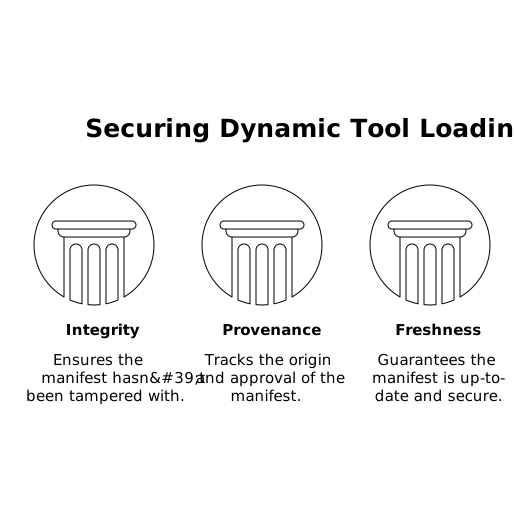
If the agent can load or update tools dynamically, the manifest becomes a supply-chain artifact. You want three properties: integrity (it wasn’t altered), provenance (who approved it), and freshness (it’s not a replay of an older, vulnerable manifest).
What to sign
- Tool definition bundle: schemas, auth requirements, base URLs, allowed HTTP methods, and parameter constraints.
- Execution metadata: minimum required runtime version, policy version, and any feature flags that affect tool access.
- Safety annotations: required user confirmation, data sensitivity labels, and whether outputs may be stored or cached.
How to structure the signature workflow
- Generate a canonical JSON representation so whitespace/order changes don’t create signature confusion.
- Sign in CI with a protected key or KMS-backed signer after review gates pass.
- Enforce verification at startup and at load time. If verification fails, the agent should refuse the tool set and fall back to a safe mode.
- Include anti-replay with a short validity window, a monotonic version, or an issuance timestamp that’s checked against your deployment environment.
Signed manifests also make incident response faster: you can answer “which tool bundle was running” with certainty, and you can rotate to a known-good manifest without guessing what changed.
Runtime policy enforcement for every tool call
Pinning and signatures reduce the chance of a compromised definition, but they don’t stop an agent from using a legitimate tool in an unsafe way. Runtime enforcement is the last line of defense, and it’s where most teams underinvest.
Build a tool firewall (policy gateway)
Place a policy layer between the agent and external tools. Whether it’s an API gateway, a dedicated “tool router” service, or edge middleware, the gateway should be able to evaluate each call before it executes.
This is a natural fit for an Internet-scale security and connectivity platform like cloudflare.com, where routing, identity-aware access, and request inspection can be composed into a consistent control plane for tool traffic—especially when tools span multiple clouds and SaaS endpoints.
Policy checks that matter
- Allowlist by tool and endpoint: the agent may call “payments.createCharge” but not “payments.exportAll”.
- Argument validation: enforce JSON schema with strict types, max lengths, regexes for URLs/domains, and forbidden fields.
- Data loss prevention rules: block secrets, tokens, raw customer PII, or internal URLs from leaving the boundary unless explicitly permitted.
- Permission scoping: map tools to least-privilege credentials; avoid sharing a single “agent super-token”.
- Human-in-the-loop triggers: require confirmation for high-impact actions (refunds, deletes, exports, permission changes).
- Rate limits and anomaly detection: stop bursty, repetitive, or novel call patterns that suggest jailbreak-by-proxy.
Make policy evaluation deterministic
Policies should not depend on the model’s self-reported intent. Base decisions on the structured call: tool name, endpoint, parameters, authenticated identity, and data classification. Store policies in versioned form and log policy decisions with a reason code so you can audit and tune without guesswork.
Operational practices that keep controls from decaying
- Separation of duties: developers can propose tool updates; a security reviewer signs manifests; production only loads signed bundles.
- Continuous diffing: alert on any drift between runtime-loaded tools and the signed manifest digest.
- Credential rotation and blast-radius drills: assume a tool token leaks; practice revocation and downgrade to a restricted tool set.
- Incident playbooks: predefine how to freeze upgrades, roll back manifests, and temporarily disable classes of tool calls.
Putting it together as a hardened tool-integration pipeline
A robust setup looks like this: you vendor tool schemas, pin dependencies and runtime, run contract tests, produce a canonical manifest, sign it in CI after review, and deploy it behind a runtime policy gateway that enforces allowlists, validation, and least-privilege credentials on every call. This layered approach prevents silent drift, detects tampering, and constrains damage even if the model is manipulated into attempting unsafe actions.