Why event-driven reliability matters in no-code frontends
Modern “no-code frontend” apps are no longer just forms and dashboards. They orchestrate multi-step automations: create a record, call multiple APIs, trigger an email, wait for a webhook, update status, and notify a user. The reliability challenge is that frontends sit at the edge of flaky networks and unpredictable integrations. A user double-clicks a button, a mobile connection drops, a webhook arrives twice, or a third-party API times out. Without a reliability layer, the outcome is familiar: duplicated orders, partial updates, and tickets that start with “I clicked once.”
Event-driven design helps because it breaks long workflows into discrete, observable steps. But “event-driven” isn’t automatically “reliable.” You still need patterns that guarantee safe replays and controlled failure. The three most practical patterns to implement—even in no-code contexts—are idempotency keys, retries with backoff, and dead-letter queues (DLQs).
Idempotency keys as the foundation for safe replays
An idempotency key is a unique identifier that makes a request safe to repeat. If the same action is submitted twice with the same key, the backend returns the same outcome instead of performing the action twice.
Where idempotency breaks in multi-step automations
Most multi-step flows fail at the boundaries:
- User interactions: double submits, refreshes, or back button behavior.
- Network ambiguity: the frontend doesn’t know if the server received the request.
- Webhook duplication: many providers deliver the same event more than once.
- Retries: your own retry logic can create duplicates if the server isn’t idempotent.
How to generate and scope idempotency keys
The key should be:
- Unique per logical action: “place order” should have a different key from “update shipping.”
- Stable across retries: store it client-side (state) for the duration of the attempt.
- Bounded in time: backends typically expire idempotency records (for example, after hours or days).
A practical approach for no-code frontends is to generate a UUID when the user initiates an action, then attach it to every request for that action in a header (commonly Idempotency-Key) or as a request field if headers are not supported by your connector.
What the backend must do
Idempotency cannot be fully solved in the frontend. The backend (or a workflow service) must store the key with a fingerprint of the request, then return a cached result for duplicates. If you’re using database-backed APIs, this often means a dedicated idempotency table keyed by (key, endpoint) or (key, userId), plus a stored response body and status.
Retries that respect the system, not just the happy path
Retries are essential for transient failures—timeouts, 502s, rate limits, temporary network loss. But retries without discipline create thundering herds, duplicated side effects, and long “spinner” experiences.
Classify failures before retrying
A reliable automation distinguishes:
- Retryable: timeouts, connection resets, 429 rate limits, 5xx errors.
- Non-retryable: validation errors (400), auth failures (401/403), “not found” (404) when it indicates a logic bug.
- Unknown: ambiguous cases where you should retry only if idempotency is guaranteed.
In an event-driven setup, the safest posture is: retry only when the operation is idempotent or protected by an idempotency key.
Use exponential backoff with jitter
Backoff prevents simultaneous retries from overwhelming a dependency. Jitter (randomness) prevents synchronized retry waves. Even if your no-code platform doesn’t expose advanced retry controls, you can often emulate them by scheduling the next attempt (e.g., “retry after 30 seconds,” then “2 minutes,” then “5 minutes”).
Keep the UI honest during long retries
Frontends should avoid pretending a multi-step workflow is “instant.” A better pattern is to submit a command, get back a tracking ID, and render status updates via polling or events. This is where a visual development platform can help: build a stateful UI that reflects processing, needs attention, or completed, rather than relying on one long synchronous request.
Dead-letter queues as the safety net for what still fails
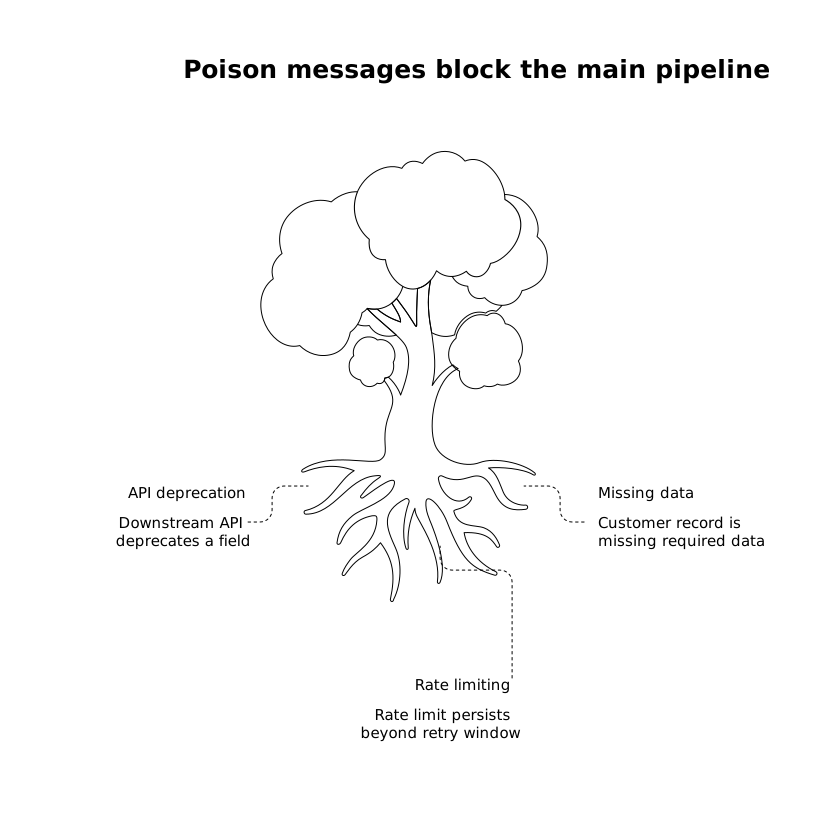
No matter how careful your retries are, some events will never succeed: a downstream API deprecates a field, a customer record is missing required data, or a rate limit persists beyond your max retry window. A dead-letter queue (DLQ) is where those “poison messages” go after repeated failures so they can be inspected and handled without blocking the main pipeline.
What belongs in a DLQ record
A DLQ entry should be actionable, not just a blob of logs. Capture:
- Event name and version (schema version matters during migrations).
- Idempotency key and correlation ID (to trace the full workflow).
- Attempt count and timestamps.
- Last error code and a short error summary.
- Payload snapshot (with sensitive fields redacted).
Operational workflows: replay, fix-forward, and alerting
DLQs are only useful if someone can do something with them. Define three explicit actions:
- Replay: reprocess the same event once the dependency is healthy.
- Fix-forward: correct data (or map fields) and replay with the same idempotency key where appropriate.
- Dismiss with reason: sometimes the correct action is to stop trying and record why.
Pair this with alerting thresholds: one DLQ item might be noise; 50 in ten minutes might be an outage.
Putting it together for a multi-step automation
Consider a typical multi-step flow initiated from a no-code frontend:
- User clicks “Provision workspace.” The frontend generates an idempotency key and submits a command.
- A backend workflow emits events for each step: create workspace, assign roles, configure billing, send welcome email.
- Each step is retried with exponential backoff on transient errors, always keyed by the same idempotency key for that step.
- After max attempts, the failed event is sent to a DLQ with context for debugging and replay.
- The frontend shows real-time status, and offers a human-friendly “Retry provisioning” button that triggers a safe replay.
This structure prevents duplicates, keeps the UI responsive, and gives operators a clear path to recovery.
Where WeWeb fits in an event-driven reliability architecture
When you build the frontend for these automations, the key is consistent state management and predictable API interactions. WeWeb is designed for production-grade applications, including complex workflows with branching logic, while keeping you in control of your deployment and code ownership. Using weweb.io, teams can model the UX around asynchronous processing (tracked statuses, step-by-step progress, and safe re-submission) rather than forcing everything into a single request-response cycle.
In practice, this often pairs well with a backend like Xano or Supabase, a message broker or workflow engine, and a clear event schema. If you’re designing first-party event trails for reliability and measurement, the mental model overlaps with attribution and instrumentation; the same discipline used in first-party event attribution for B2B sales cycles helps ensure your automation events are consistent, traceable, and replayable.
Implementation checklist for reliable no-code automations
- Define event boundaries: each step emits an event and has a single responsibility.
- Add idempotency keys to every side-effecting command and step.
- Design retry rules: which errors retry, max attempts, backoff strategy, time budget.
- Instrument correlation: correlation ID across frontend, workflow, and integrations.
- Stand up a DLQ: store context, provide replay tools, and set alert thresholds.
- Make UI states explicit: processing, succeeded, failed, needs input—avoid infinite spinners.
If you treat retries and replays as normal (not exceptional), event-driven no-code frontends become dramatically more dependable—without turning your product into a support queue.