
The Opportunity Cost Ledger for Feature Requests
Most product teams have a familiar problem: the feature request list grows faster than the roadmap. The hard part isn’t identifying what customers want—it’s quantifying what you lose by not building the “top” requests, and recognizing when a highly requested idea is still the wrong bet.
The Opportunity Cost Ledger is a lightweight method to make that trade-off visible. It turns prioritization from a debate about “what’s loudest” into a repeatable decision based on foregone revenue, retention risk, strategic drift, and execution drag. It’s simple enough to run in a weekly triage meeting, but structured enough to hold up under executive scrutiny.
Why top requests still mislead smart teams
A request can rank high for reasons that don’t correlate with business outcomes: a single large customer with a unique workflow, a noisy segment you over-serve, or a workaround that feels painful but rarely blocks renewal. Without a consistent accounting of trade-offs, teams fall into two traps:
- “Vote-count prioritization” that rewards the largest pile, not the highest impact.
- “Story-driven prioritization” where the most compelling anecdote wins.
The ledger doesn’t eliminate judgment; it disciplines it. It forces every “yes” to be recorded as a set of “no’s.”
What the ledger is and what it is not
The Opportunity Cost Ledger is a small table you keep alongside your feature request queue and roadmap. For any candidate feature, you record two things:
- Value you expect to gain if you build it.
- Value you expect to lose by not building the next best alternatives with the same time.
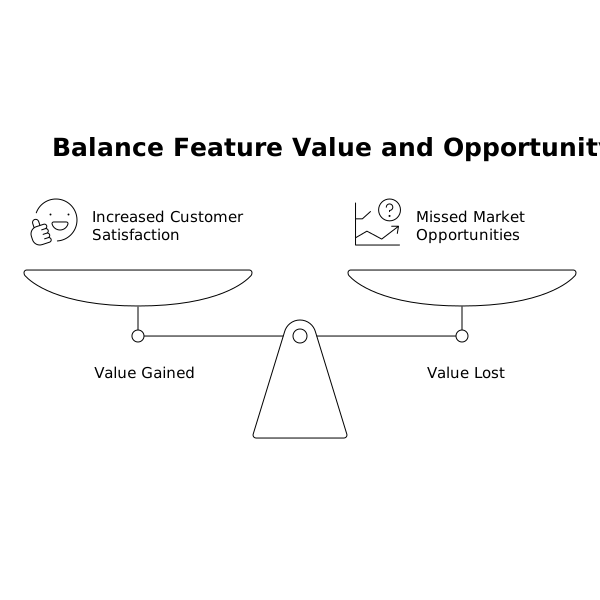
It is not a replacement for discovery, customer interviews, or product strategy. It’s a compact “accounting layer” that makes trade-offs explicit and comparable across requests.
How to build an Opportunity Cost Ledger in under an hour
1) Start with a short, stable unit of capacity
Pick a consistent unit so comparisons stay honest: two weeks of one squad, one sprint, or 20 engineering-days. Don’t overfit. The goal is repeatability.
2) Normalize each request into the same decision record
Before scoring, ensure each request has the minimum fields:
- Job-to-be-done: what the customer is actually trying to accomplish
- Affected segment: plan, persona, industry, or use case
- Workarounds today: how users are solving it without you
- Definition of done: what “shipped” means for this request
This is where a feedback platform becomes more than a list. With a tool like canny.io, you can centralize requests, deduplicate similar ideas, and attach context like account value and segment—all of which makes the ledger far less guessy.
3) Score gains and losses with a few consistent columns
Keep columns minimal. A practical ledger fits on one screen:
- Demand signal: number of customers, but weighted by segment importance
- Revenue upside: expansion potential, sales cycle unlocks, or pricing power
- Retention risk: churn probability if unaddressed
- Strategic alignment: does it reinforce your product narrative
- Time-to-value: how quickly customers will benefit after release
- Execution drag: long-term maintenance, support burden, edge cases
Use a simple scale (e.g., 1–5) and a short note justifying the score. The justification is the real asset; the number is the index.
4) Add the “next best alternative” column
This is the part most prioritization frameworks omit. For each candidate feature, list the 1–3 things you would not do if you choose it. Then estimate what you’d lose by skipping them for one capacity unit.
Examples of alternatives that often beat “another feature”:
- Fixing a reliability issue that silently reduces activation
- Improving onboarding so the same demand converts with less support
- Hardening integrations to reduce churn driven by broken workflows
If you run event-driven workflows, the opportunity cost can be plain: spending a sprint on a new UI request might mean not implementing idempotency and retries that prevent revenue-impacting failures. (If this is a recurring pain point, see reliable event-driven no-code frontends for a systems-oriented view of making workflows resilient.)
5) Compute a simple decision view
You don’t need a complicated formula. A useful view is:
- Net value: (expected gain) − (opportunity cost of skipped alternatives)
- Confidence: low/medium/high based on quality of evidence
Two features can have the same net value, but different confidence. The ledger makes it acceptable to choose the higher-confidence path, and to postpone “big bets” until you’ve earned more evidence.
When to say no, even to a top request
The ledger is also a refusal framework. A clean “no” is easier when you can point to the trade-off that would be incurred.
Common “no” patterns that the ledger surfaces:
- High demand, low leverage: many requests, but mostly from low-retention segments or users who aren’t in your ICP.
- Revenue mirage: sales believes it will close deals, but there’s no proof it’s a true blocker versus a nice-to-have.
- Execution drag outweighs benefit: the feature creates ongoing complexity (permissions, edge cases, support load) that taxes every future release.
- Strategic drift: the request pushes you toward a different product category; the opportunity cost is losing focus on what you win at.
How to operationalize the ledger in your feedback workflow
Make it a weekly ritual, not a quarterly exercise
Opportunity cost changes as your product and market change. Review only the top slice of requests each week (for example, the top 10 by demand or revenue-weighted demand). This keeps the process light.
Attach decisions back to the request
The ledger isn’t helpful if it lives in a spreadsheet nobody checks. Tie each decision to the original feedback item: what you decided, why, and what you chose instead. A platform designed for closing the loop makes this natural—especially when it supports roadmaps and release notes in the same workspace.
Use a “response standard” for consistency
Stakeholders judge you less on the answer and more on whether the process is fair. Use a consistent response pattern: summarize the use case, acknowledge impact, share your current priority, and name the trade-off you’re making. If you need a structured way to set expectations, The Feedback SLA Playbook for Feature Requests pairs well with the ledger approach.
What changes when you adopt the ledger
Teams that keep an Opportunity Cost Ledger tend to ship fewer “obvious” features and more compounding improvements: reliability, activation, integration sturdiness, and workflow coherence. They also get faster at saying no without sounding dismissive—because the decision is framed as protecting higher-leverage outcomes, not ignoring customer voices.
Most importantly, the ledger creates a shared language across product, engineering, and go-to-market: every request is a choice, and every choice has a cost.