
Why “freshness” matters more than raw demand
Feature requests age. Some become more urgent as workflows evolve; others quietly lose relevance as markets shift, integrations change, or customers adopt workarounds. Yet many teams still prioritize feedback as if every upvote and comment has the same weight forever.
A practical way out is to add a “Feedback Freshness” metric to your prioritization. Freshness isn’t about ignoring older ideas. It’s about measuring whether a request still reflects today’s reality—and whether building it now would create impact or just satisfy a historical artifact of your roadmap.
In a feedback hub like canny.io, freshness becomes especially powerful because it can be evaluated alongside demand, customer segment, and revenue impact—without turning prioritization into a purely subjective debate.
Defining the Feedback Freshness metric
Feedback Freshness is a score (or a set of signals) that estimates how “current” a request is. The goal is not to predict the future perfectly; it’s to detect when the evidence you’re using to justify building something is outdated.
A simple definition:
- Fresh request: Recent confirmations exist that the problem persists, is costly, and is not already solved by new product capabilities or changed customer behavior.
- Stale request: The request is old, hasn’t been reaffirmed in a long time, and may have been made under constraints that no longer apply.
Freshness is not the same as recency
A request posted two years ago can still be fresh if it has continued validation, clear ongoing pain, and current context. Meanwhile, a request posted last month can be stale if it’s driven by a one-off incident, a temporary integration outage, or a misunderstanding that is already resolved.
The four signals that reveal staleness
You don’t need a complicated model. Most teams can identify staleness using four signals that are easy to instrument and hard to argue with.
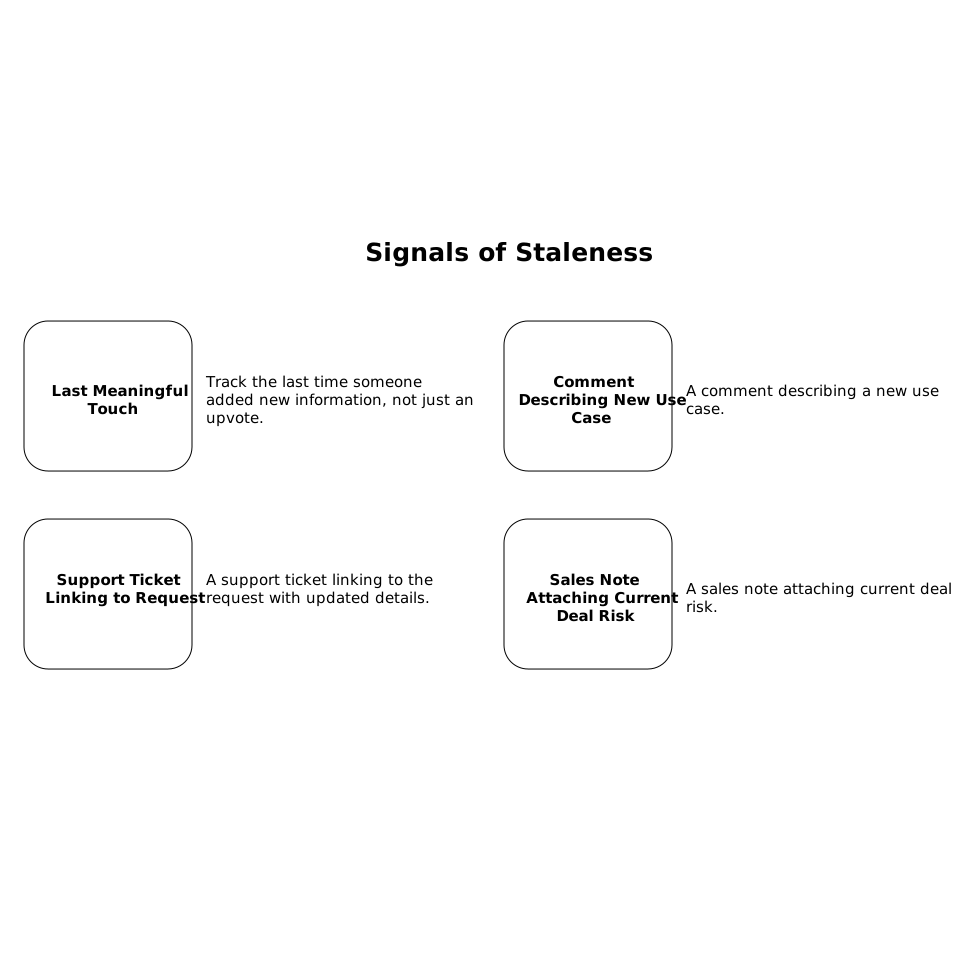
1) Last meaningful touch
Track the last time someone added new information—not just an upvote. Examples include:
- a comment describing a new use case
- a support ticket linking to the request with updated details
- a sales note attaching current deal risk
If the last meaningful touch is far in the past, you may be prioritizing based on historical conditions.
2) Confirmation velocity
Fresh requests tend to attract confirmations at a steady pace: similar accounts surface the problem repeatedly. Stale requests often show a spike (a launch, outage, or workflow change) and then nothing.
Velocity helps you distinguish “this mattered once” from “this keeps happening.”
3) Context drift
Context drift is the gap between the environment when the request was made and the environment today. Drift happens when:
- you shipped adjacent features that change the best solution
- customers adopted new tools (or your integration landscape changed)
- regulatory or security expectations shifted
- AI-assisted workflows made the original request less relevant
Drift doesn’t automatically kill a request—it changes what “building it” should mean.
4) Workaround saturation
If customers have found stable workarounds, the request may be stale from a product ROI standpoint—even if the idea is still liked. Watch for comments like “we solved this with a Zap,” “we built an internal script,” or “we changed our process.”
Workarounds can also signal opportunity: if the workaround is costly, fragile, or high-risk, the request may still be worth building, but the product spec should target replacing that workaround cleanly.
How to score freshness without over-engineering
A straightforward approach is a 0–100 score composed of a few weighted components. Keep it interpretable so product, support, and sales can use it consistently.
A practical scoring template
- Time since last meaningful touch (0–40 points): more recent = higher
- Confirmation velocity (0–25 points): steady/accelerating = higher
- Context drift penalty (0 to -20 points): high drift reduces score
- Workaround cost (0–15 points): expensive/risky workarounds increase score
You can start even simpler with a three-level label (Fresh / Aging / Stale) and convert it into a number later when the team trusts the concept.
When stale feedback is still worth building
Some “stale” requests should move forward anyway. Freshness is a decision input, not a veto. Here are cases where older feedback can still be the best roadmap move.
The request maps to a strategic capability
If the request aligns with a durable strategy—platform extensibility, enterprise admin controls, data governance, reliability—its age matters less. Strategy-backed work has longer time horizons, and the initial request may simply be the earliest visible evidence.
The request is quiet because it’s painful to report
Certain problems generate fewer comments because they’re hard to articulate (permissions, compliance, edge-case data quality). These can look stale even when they’re urgent. If support and success teams keep encountering the issue, treat that as “freshness by proxy.”
The request is a pricing or packaging lever
Sometimes a feature request is really a segmentation signal: a subset of customers needs an advanced workflow. Even if the thread is old, building it could unlock a clearer plan tier boundary, reduce churn in a specific segment, or increase expansion.
Operationalizing freshness inside your feedback workflow
Freshness only helps if it changes decisions. That means making it visible where prioritization happens and defining what actions to take when a request crosses freshness thresholds.
Create “revalidation” loops, not one-time triage
Set a policy: if a request hasn’t had a meaningful touch in X days, it enters revalidation. Revalidation can be as lightweight as:
- a short outreach to 3–5 representative requesters
- a support macro asking for current examples
- a sales check: “Does this still block deals?”
To keep revalidation from becoming chaos, tie it to a clear internal process—similar to the approach described in a feedback SLA playbook for feature requests.
Use freshness to improve deduplication and summaries
Staleness often hides in duplicates: many old posts are really earlier versions of the same need. When you centralize feedback and cluster similar items, you can update a single canonical request with current context and retire outdated variants.
This is where AI-assisted workflows can help: capturing feedback from support calls and customer emails, then summarizing threads so the “last meaningful touch” is easy to see. Canny’s Autopilot-style automation fits naturally here because freshness relies on ongoing signals, not one-time intake.
Close the loop without resurrecting dead ideas
When a request is stale, silence is costly: customers assume it’s ignored. But over-promising is worse. A helpful pattern is to communicate in one of three ways:
- Revalidated: “We’re reviewing this again—can you confirm your current workflow?”
- Superseded: “A newer feature/approach now covers this need; here’s how.”
- Deprioritized with context: “Still valuable, but not aligned with near-term focus; we’ll revisit if signals return.”
The outcome: fewer zombie requests, stronger roadmap confidence
Adding a Feedback Freshness metric makes your roadmap more honest. It reduces “zombie” items that linger because they once sounded important, and it rewards the requests that continue to prove their value over time. Most importantly, it gives product teams a shared language for a common tension: honoring customer input while acknowledging that the world changes.
Freshness won’t replace judgment, but it will upgrade it—especially when paired with centralized feedback, segmentation, and clear operating rules inside tools like Canny.
Vertical Video