
The hidden KPI problem that starts at midnight
If you’ve ever compared “yesterday” across ad platforms, analytics, and CRM systems and wondered why the totals don’t reconcile, you’ve likely run into the timezone split-brain problem. It’s subtle: each system has its own definition of when a day starts and ends. But it’s also destructive: the same customer actions can be counted on different dates depending on the source, quietly corrupting cross-channel KPIs.
This isn’t a dashboard problem. It’s a data pipeline problem. Fixing it at the pipeline layer—once—prevents endless spreadsheet patches, ad hoc filters, and “just trust platform X” arguments.
What “split-brain” looks like in marketing data
In distributed systems, a split-brain happens when different nodes act as if they have the correct state. In marketing analytics, the “nodes” are channels and tools, and the “state” is time. Each source is confident its daily totals are right—within its own timezone and reporting rules.
Common symptoms include:
- Daily spikes and dips around midnight that don’t match campaign changes.
- Paid vs. web analytics mismatches (e.g., ad clicks on one date, sessions on another).
- Lead and revenue attribution drift when CRM timestamps are stored in UTC but viewed in local time.
- Budget pacing errors when “today spend” is defined differently across platforms.
Why midnight boundaries corrupt cross-channel KPIs
Each platform defines “a day” differently
Some platforms default to the ad account’s timezone, others to the property’s timezone, others to UTC, and some allow partial configuration. Even within one vendor ecosystem, settings can vary by account, property, or data view. When you stitch these sources together without harmonizing time, you’re effectively combining different calendars.
ETL schedules add an invisible second timezone
Your pipeline’s extraction schedule becomes its own time boundary. If you pull data at 01:00 UTC, “yesterday” might be complete for one source and still incomplete for another (due to processing lag). The result is a recurring bias: certain channels look weak early in the day and “catch up” later—except your stakeholders already acted on the earlier numbers.
Attribution windows amplify the discrepancy
Many advertising platforms attribute conversions back to click time, while analytics tools often report events by event time. A conversion at 00:10 local time might be “today” in analytics, but attributed to a click “yesterday” in ads. Without a consistent time model, the KPI you call “daily ROAS” is mixing incompatible definitions.
The data pipeline layer is the right place to fix it
Trying to solve timezone issues purely in BI is tempting: add a calculated field, shift timestamps, call it done. But BI fixes rarely scale because each dashboard, analyst, and model tends to implement a slightly different version of the same logic.
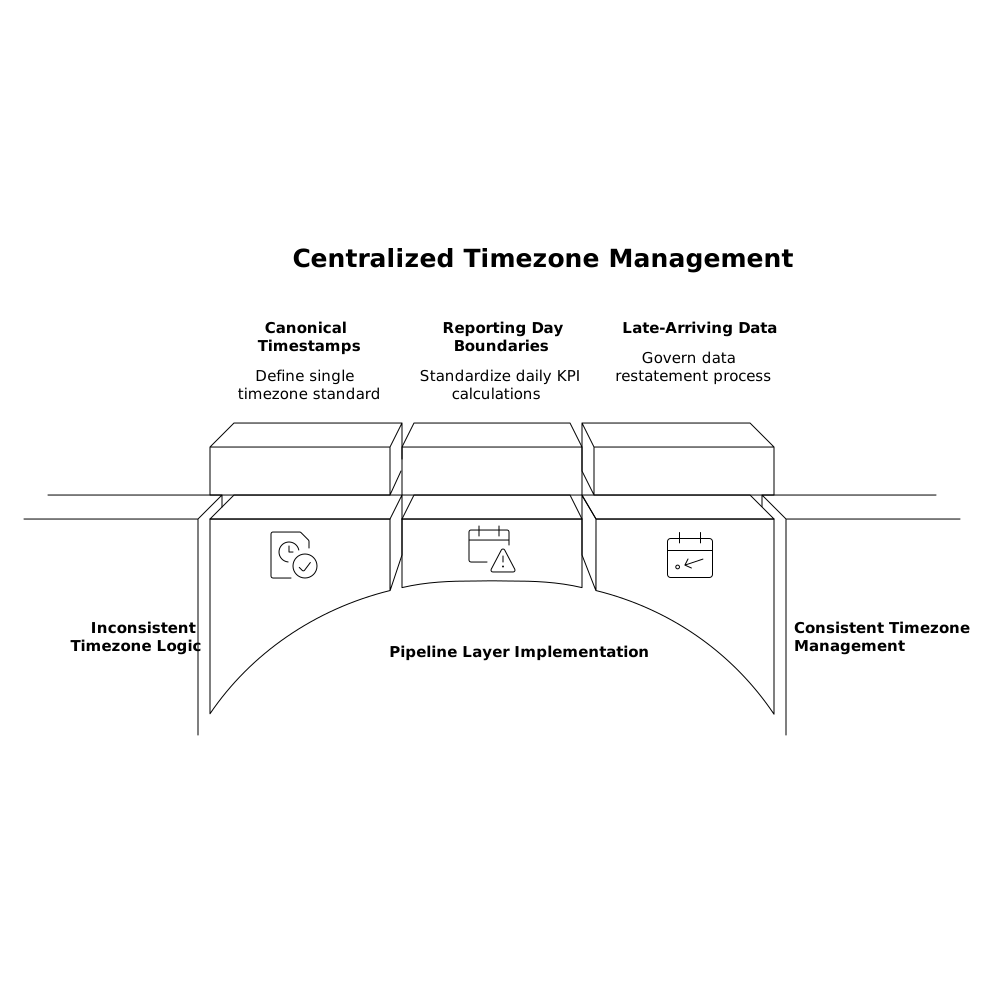
At the pipeline layer, you can implement a single, governed definition of:
- Canonical timestamps (what is stored and in what timezone)
- Reporting day boundaries (what counts as a “day” for KPIs)
- Late-arriving data handling (what gets restated, when, and how)
This is where a marketing data infrastructure approach is valuable. With Funnel.io, teams centralize collection and standardization across advertising, analytics, and CRM tools, making it practical to enforce consistent timezone and KPI logic before data hits dashboards or warehouses.
A practical blueprint to eliminate timezone split-brain
1) Separate event time from reporting time
Store raw timestamps in a canonical format (typically UTC) as event_time_utc. Then create explicit reporting dimensions such as reporting_date based on a chosen business timezone (e.g., America/New_York) and rules you can explain.
Key point: don’t overwrite raw time. Add derived fields. When stakeholders dispute a number, you want the ability to trace back to the original event.
2) Define one business timezone for cross-channel KPIs
Pick a business timezone that matches how the organization plans and budgets. This is not always the same as the ad account timezone, especially for global teams. Document it and apply it consistently to cross-channel reporting tables.
If you genuinely need multiple timezones (regional reporting), model them explicitly: one dataset per region or a dimension-driven approach—not a mix of implicit assumptions.
3) Normalize platform “date” fields instead of trusting them
Many APIs return a date that is already aggregated according to the platform’s rules. That field can be useful, but it’s not neutral. When possible, prefer timestamp-level exports (events, hourly breakdowns) and compute reporting dates yourself. If timestamp-level isn’t available, capture the platform timezone and aggregation rules as metadata so the limitation is visible downstream.
4) Build a late-data and restatement policy
Marketing and CRM data often arrives late: conversions get reattributed, revenue is adjusted, offline conversions are uploaded, or systems backfill. Decide how many days you will restate (e.g., rolling 7 days) and bake that into the pipeline refresh strategy.
This single decision prevents a common failure mode: “Yesterday changed again” surprises that erode trust. With a defined restatement window, changes are expected and bounded.
5) Create KPI tables that are explicitly cross-channel
Instead of letting every dashboard join raw channel tables differently, publish curated KPI tables designed for cross-channel comparisons (spend, clicks, sessions, leads, revenue), each with the same reporting_date definition and consistent naming conventions.
This is also where you standardize currencies, campaign naming harmonization, and metric definitions so that “cost” or “revenue” doesn’t mean five different things depending on the connector.
How to validate the fix without endless reconciliation
Timezone fixes should be testable. A few checks that catch most issues:
- Midnight drift test: compare hourly totals around midnight in the business timezone; look for unnatural step changes after transformation.
- Cross-source day alignment: pick a known campaign day and verify spend, clicks, and sessions align to the same reporting_date rules.
- Restatement audit: track how much the last 1, 3, and 7 days change over time; large changes indicate either attribution volatility or extraction timing gaps.
- Metadata completeness: ensure each source table includes source_timezone, extraction_time_utc, and transformation versioning for traceability.
What you gain when midnight stops being a moving target
When day boundaries are consistent, cross-channel KPIs stop behaving like a negotiation. Pacing becomes reliable. Channel comparisons become fair. Forecasting improves because the daily series is no longer distorted by timezone artifacts. Most importantly, analysts spend less time defending numbers and more time improving performance.
Solving it at the pipeline layer means the fix travels with the data—into your warehouse, dashboards, spreadsheets, and models—so every consumer inherits the same definition of “today” and “yesterday,” even when the underlying platforms disagree.
Vertical Video