Why a Feedback SLA matters for feature requests
A feature request is rarely “just feedback.” It’s often a churn risk, a sales blocker, or a signal that your product narrative is drifting from real use cases. The problem is that most teams treat feature requests like an inbox: read when convenient, answered inconsistently, and escalated only when someone yells loudly enough. A Feedback SLA changes that by making response time targets, ownership rules, and escalation paths explicit—so customers feel heard and your team stays in control.
This playbook focuses on the part most organizations miss: not the roadmap decision itself, but the operational layer that prevents requests from going dark. The goal is predictable handling: every request gets triaged, acknowledged, and routed with a defined clock and a named owner—whether you build it or not.
Define what “response” means before you set the clock
Teams commonly set an SLA (e.g., “Respond in 48 hours”) without defining what counts as a response. For feature requests, you typically need three response types, each with a different level of effort:
- Acknowledgment: a quick confirmation the request was received, with next steps.
- Clarification: targeted questions to capture the use case, constraints, and impact.
- Status decision: a clear state such as “Under review,” “Planned,” “Not planned,” or “Need more input.”
A practical Feedback SLA usually guarantees the first two, and time-boxes the third. This keeps you honest without forcing premature roadmap commitments.
Set response time targets that match business risk
Instead of one universal SLA, use tiers based on customer impact and urgency. A simple tiering model that works across support, product, and sales:
Tier 1: Revenue or retention risk
- Examples: renewal at risk, enterprise deal blocked, repeated complaints from a key segment.
- Target: acknowledgment within 4 business hours; clarification within 1 business day; initial status within 5 business days.
Tier 2: Common workflow gap
- Examples: request shows up across many accounts, but not tied to immediate churn.
- Target: acknowledgment within 1 business day; clarification within 3 business days; status within 10 business days.
Tier 3: Nice-to-have or edge case
- Examples: cosmetic asks, niche integrations, one-off preferences.
- Target: acknowledgment within 3 business days; status within 20 business days.
The key is that targets are measurable and realistic. If your team can’t consistently hit them, the fix is not “try harder”—it’s to reduce intake friction, increase triage bandwidth, or narrow what qualifies as a request.
Assign ownership rules so requests never orphan
Feature requests cross functional boundaries. A clean ownership model separates who replies from who decides:
- Feedback owner (Responder): accountable for meeting the SLA clock and keeping the requester informed.
- Product owner (Decider): accountable for prioritization outcomes and roadmap alignment.
- Domain reviewer (Consulted): engineering, security, data, or design reviewers who assess feasibility and risk.
In practice, the responder is often Support, Customer Success, or a Product Ops function. The decider is typically the PM for that product area. When this is ambiguous, the request stalls and the SLA becomes meaningless.
Platforms built for feedback workflows help here because every item has a clear status and owner, with activity history. Many teams use canny.io as the central workspace to route requests from a public portal and internal sources, deduplicate similar asks, and keep accountability visible without turning it into another spreadsheet project.
Use a consistent lifecycle with statuses your team can defend
Customers don’t need perfect certainty; they need clarity. A minimal, defensible feature-request lifecycle looks like this:
- New: captured and awaiting triage.
- Needs details: clarification required; questions sent.
- Under review: being evaluated for fit, impact, and feasibility.
- Planned: committed to a timeframe window (even if broad).
- In progress: work started.
- Shipped: released, with notes and rollout details.
- Not planned: explicitly declined, with rationale and alternatives.
The SLA should attach to transitions: “New” to “Needs details/Under review” within the acknowledgment window; “Under review” to “Planned/Not planned” within the decision window for the tier.
Build an escalation path that’s structured, not political
Escalation is not a failure; it’s a safety valve. What hurts teams is ad hoc escalation: a Slack message to a friendly PM or an exec forward that jumps the queue. A fair escalation path uses triggers and timeouts:
Escalate by trigger
- Commercial trigger: opportunity amount or renewal value above a threshold.
- Risk trigger: compliance, security, or data integrity implications.
- Volume trigger: request reaches a vote/comment threshold or appears across multiple segments.
Escalate by timeout
- Stage timeout: “Under review” for more than X days without an update.
- Clarification timeout: customer responded, but no internal follow-up within Y days.
Route escalations to the smallest group that can unblock action: the relevant PM first, then the product lead, then a weekly triage council. If you need a cadence that respects both deep work and stakeholder needs, borrowing a structured weekly planning rhythm can prevent escalations from becoming constant interruption; see this two-clock weekly planning ritual for a pragmatic approach to balancing maker and manager time.
Operational tactics that make the SLA achievable
1) Standardize the intake fields
Most “slow response” problems are actually “missing context” problems. Require just enough structure to act: what job the customer is trying to do, current workaround, urgency, and expected outcome. Keep it lightweight; you can always follow up.
2) Deduplicate early, not after the backlog is messy
Duplicates dilute signal and waste response capacity. A dedup habit ensures you respond once with a clear canonical thread and attach related requests to it. If you use tooling with automation, AI-assisted deduplication can reduce the manual triage load so you can meet tighter acknowledgment targets without increasing headcount.
3) Separate “customer messaging” from “internal evaluation”
Your internal feasibility review can be messy. Your customer updates should be consistent: what you heard, what happens next, and when they can expect another update. Keep the language stable and avoid accidental commitments.
4) Close the loop automatically when status changes
Feature-request SLAs fail quietly when shipping happens but nobody circles back to notify requesters. Tie lifecycle changes to outbound updates—release notes, product updates, and targeted notifications. This is also where prioritization discipline matters: if your team is constantly over-committed, consider implementing explicit WIP limits; WIP budgets for high-velocity teams can help you protect delivery capacity and keep “Planned” meaningful.
How to measure a Feedback SLA without gaming it
Pick a small set of metrics that reflect real customer experience:
- Time to first acknowledgment: median and 90th percentile by tier.
- Time in “Under review”: aging report with escalation thresholds.
- Reopen rate: how often “Shipped” or “Not planned” requests get reopened due to unclear messaging.
- Coverage: percentage of requests with an owner and a next-update date.
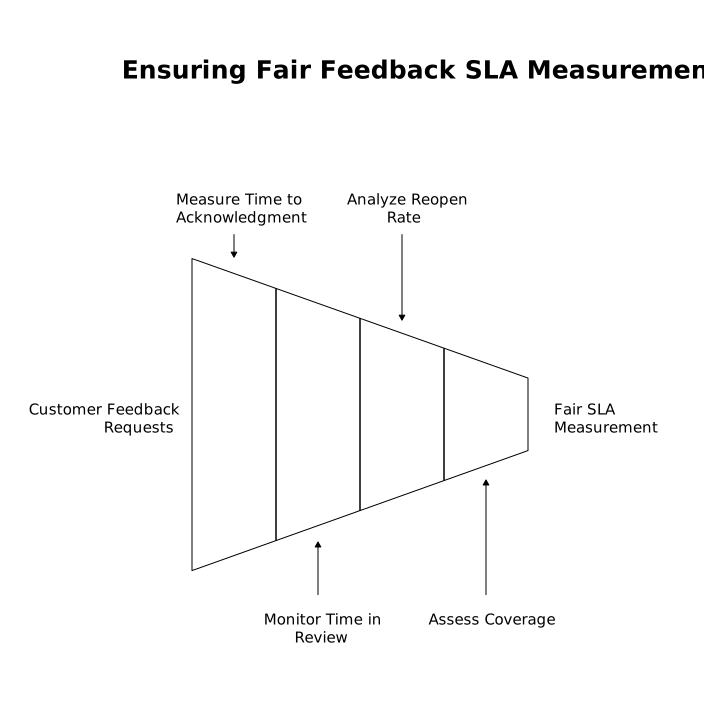
A healthy SLA system doesn’t maximize “speed at all costs.” It maximizes predictability and keeps the team’s promises aligned with actual capacity.
Vertical Video