Define the Feedback Flywheel metric
Most product teams track “time-to-response” on feature requests, then watch it get gamed: quick, low-information replies that reduce the number but increase noise. The “Feedback Flywheel” metric fixes that by treating response speed and response quality as a loop that should compound trust. You measure how fast you acknowledge, how quickly you clarify, and how reliably you close the loop—without rewarding empty activity.
In practice, the flywheel is a small set of linked service-level targets and outcome checks. It works especially well when your feedback is centralized and deduplicated, because you’re measuring a single request’s lifecycle rather than dozens of scattered tickets. Platforms like canny.io are built around that centralization, which makes the metric measurable at scale.
Why classic time-to-response creates noise
Pure time-to-first-response (TTFR) encourages behavior that looks good in dashboards but weakens your system:
- Auto-ack spam: “Thanks, we’ll pass this along” closes the timer but doesn’t move the request forward.
- Fragmented follow-ups: Teams ask clarifying questions in multiple threads (support, sales, portal), duplicating work.
- Premature commitment: To appear responsive, a PM hints at roadmap intent before it’s validated.
The flywheel approach keeps speed, signal, and closure connected so you can move quickly and reduce repeated back-and-forth.
The four components of the Feedback Flywheel
Think of the metric as four timestamps and two quality gates. You don’t need all of them to start, but using at least three prevents “fast but empty” responses.
1) Time to Acknowledgment (TTA)
Definition: time from request creation to a human-meaningful acknowledgment.
Meaningful doesn’t mean long. It means the requester understands that (a) the request was captured, (b) it was routed to the right place, and (c) they will hear back at a specific next checkpoint.
Anti-noise rule: Acknowledgment only counts if it includes a next step (for example, “We’ll ask one clarifying question” or “We’ll merge this with an existing request and keep updates there”).
2) Time to Clarification (TTC)
Definition: time from acknowledgment to the first clarifying interaction that reduces ambiguity.
Feature requests often arrive as solutions (“Add a button”) rather than problems (“I can’t do X”). TTC pushes you to extract the underlying job-to-be-done early, before duplicates and mis-scoping multiply.
Quality gate: Count TTC only when the clarification is tied to a structured prompt—use case, frequency, current workaround, affected segment, and what “success” looks like.
3) Time to Triage Decision (TTD)
Definition: time from clarification to a visible internal state change that indicates what happens next.
This is not “ship it.” It’s a decision like: merge into an existing request, gather more evidence, consider for next planning cycle, or decline with rationale. The point is to avoid “limbo,” where nothing is explicitly decided and the request continues to generate pings.
Anti-noise rule: TTD only counts when the request is attached to an owner and a review horizon (for example, “revisit in Q3 planning”).
4) Time to Loop Closure (TTLC)
Definition: time from triage decision to the next user-facing update that changes the requester’s understanding.
Closure can be a roadmap status change, a rationale for deprioritization, or a release note. The flywheel treats closure as a first-class event because it reduces repeated inbound questions and increases trust, which improves the quality of future requests.
Release-note and status workflows are easier when your feedback is already consolidated and deduped; that’s where a feedback platform earns its keep.
How to compute the metric without rewarding empty speed
A practical “Feedback Flywheel Score” can be tracked weekly per team or per product area. Keep it simple:
- Median TTA (hours) with the “next step included” condition.
- Median TTC (days) with the structured clarification condition.
- Median TTD (days) with owner + review horizon set.
- TTLC coverage: % of requests that receive a meaningful user-facing update within a defined window (for example, 30–60 days depending on volume).
Then add one noise counter-metric:
- Clarification rework rate: % of requests that require a second clarification round because the first response didn’t capture the use case well.
If your response times improve but rework rises, you’re optimizing the wrong thing.
Set SLAs that match request types and maturity
Not all feature requests deserve the same clock. Create two or three lanes and measure separately:
- High-signal lane: enterprise accounts, revenue impact, compliance, or churn risk. Tight TTA and TTC.
- General lane: normal portal requests. Moderate TTA; focus on good clarification.
- Idea lane: open-ended suggestions. Slow is acceptable if the triage decision is clear.
This aligns well with a structured approach to feedback SLAs; if you need a template for setting those targets and review horizons, the internal guide on feedback SLAs for feature requests pairs naturally with the flywheel model.
Operational tactics to reduce time-to-response without noise
Deduplicate early and reply once
The fastest way to reduce response load is to prevent “parallel conversations.” Consolidate duplicates into a canonical request, then respond in one place. Tools with automated capture and deduplication (including AI-assisted grouping) reduce the hidden TTC/TTD drag that comes from merging after the fact.
Use “smart clarification” prompts instead of open-ended questions
Replace “Can you tell us more?” with a fixed set of fields or a short guided prompt. It accelerates TTC and lowers rework. If you handle feedback arriving from calls and support, AI-assisted summaries can prefill the prompt so the first interaction is already specific.
Publish decision logs for repeatable triage
Noise often comes from inconsistent decisions. When requesters see different answers for similar asks, they keep pushing. Maintain a lightweight decision log: what you decided, why, what evidence you used, and when you’ll revisit. If you already formalize PRDs, converting them into reusable decision artifacts makes triage faster and more consistent; the article on turning a PRD into a decision log is a practical extension of this idea.
Separate acknowledgment from commitment
A good acknowledgment is time-bound and respectful, but avoids roadmap promises. This single habit reduces future noise because you won’t need to walk back expectations later.
What “good” looks like in a healthy flywheel
A healthy flywheel has these characteristics:
- TTA is consistently low (hours, not days), but only for acknowledgments that include a next step.
- TTC is predictable because clarification is structured and often partially automated.
- TTD is explicit—few requests sit in “no status.”
- TTLC coverage is high, so users learn that adding context leads to real updates.
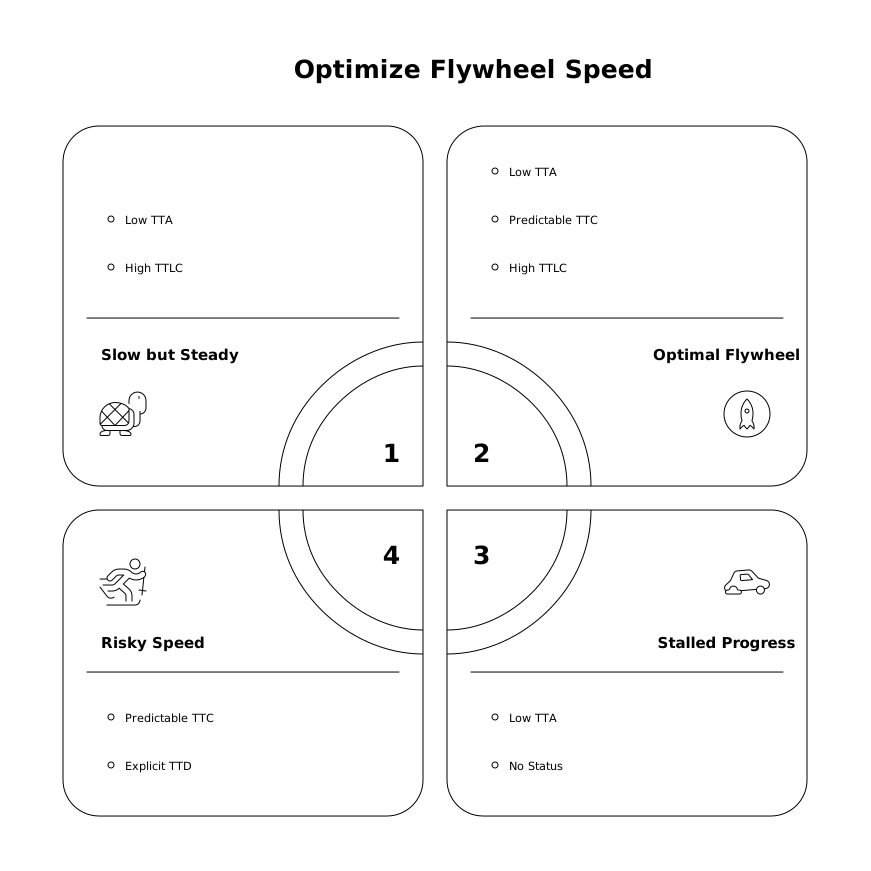
Once that trust exists, the inbound stream improves: requests become clearer, duplicates decrease, and your response burden drops. That’s the flywheel—speed and signal reinforcing each other rather than trading off.