
Why cross-channel reporting breaks quietly when OAuth access expires
The “re-auth cliff” is what happens when a connector’s OAuth grant or permissions lapse and your marketing pipelines keep running—just without new data. Dashboards don’t necessarily error. Scheduled refreshes may still “complete.” But spend, clicks, and conversions stop updating for one or more channels, and the gap blends into blended KPIs until someone notices a sudden CAC drop (or a budget that “isn’t spending”).
This is especially common in cross-channel setups where data from ad networks, analytics, and CRM tools is unified downstream. If you’re reconciling performance across multiple sources, an expired token isn’t merely a connector problem—it becomes an analytics integrity problem.
What the re-auth cliff looks like in the real world
Most teams expect token failure to be loud: an error banner, a failed job, a notification. In practice, it’s often quiet for four reasons:
- Incremental loads can succeed with zero new rows, so the pipeline reports “success,” but ingestion is stale.
- Connectors may retry with cached credentials until the refresh token itself is invalidated.
- Permissions can change without a token expiring (a user loses access, scopes are reduced, an app is unapproved), producing partial datasets.
- Downstream models smooth over the absence (rolling averages, blended views, last-known values), masking that a source stopped moving.
From a stakeholder’s perspective, this manifests as “sudden efficiency” or “a channel got cheaper”—until billing shows the opposite.
The mechanics behind token expiry and permission drift
OAuth isn’t one expiry; it’s several
OAuth-based connectors typically rely on short-lived access tokens and longer-lived refresh tokens. The cliff arrives when refresh stops working. Common triggers include:
- User revocation: someone clicks “remove access” in the ad platform.
- Password resets and security events: some platforms invalidate refresh tokens after security changes.
- App policy changes: a platform updates security requirements or re-approval rules.
- Inactivity windows: refresh tokens expire if unused for a defined period.
Connector permissions can change mid-flight
Even with valid tokens, permissions can drift:
- A connector account loses access to an ad account or property.
- A team reorganizes business managers and removes a user.
- Scopes change (read-only vs. reporting + insights), which can remove specific endpoints or breakdowns.
These aren’t theoretical edge cases—they’re normal operational churn. Without detection, they translate into silent reporting gaps.
Why spend gaps are uniquely dangerous in cross-channel metrics
Missing impressions or clicks is bad, but missing spend is worse because spend is the denominator for many decisions. A gap can distort:
- Blended CAC: understated spend makes acquisition look healthier than it is.
- ROAS and MER: revenue stays, spend disappears, and efficiency inflates.
- Budget pacing: teams reduce budgets or reallocate based on “underperforming” channels that are actually just missing data.
- Attribution readouts: multi-touch or modelled attribution inherits upstream holes, leading to false confidence in certain sources.
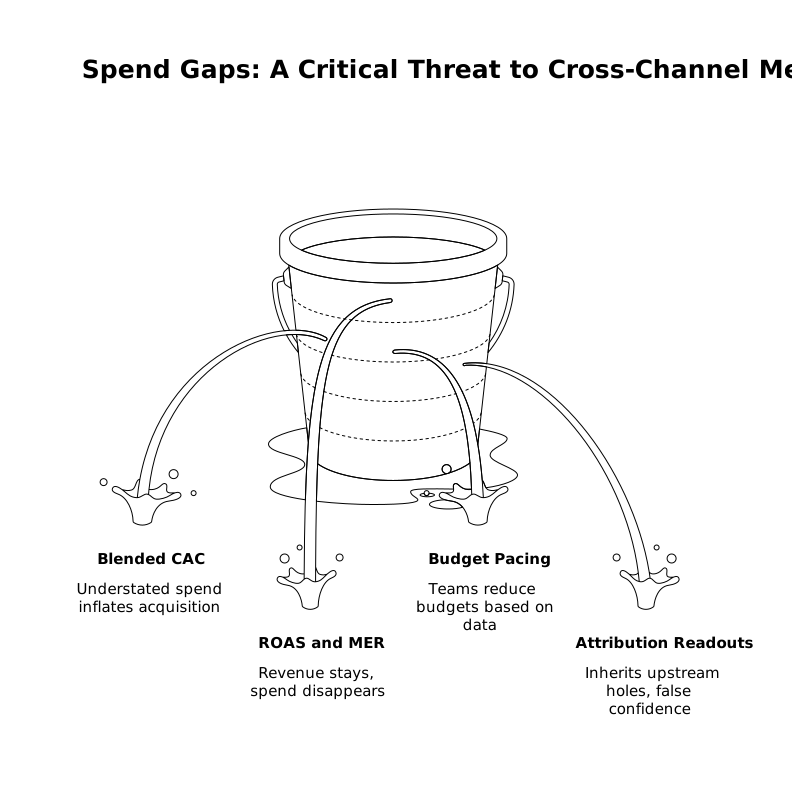
This also creates a governance problem: when leadership stops trusting the dashboard, teams fall back to manual exports and one-off spreadsheets.
Detection patterns that catch the cliff before finance does
The goal is to detect staleness and coverage loss, not just hard failures. Practical checks include:
1) Freshness SLAs per source
Define an expected update window per connector (e.g., “Meta spend must update at least once every 6 hours”). If no new data lands in that window, alert.
2) Row-count and spend-delta anomaly checks
Track daily row counts and spend deltas per channel. A sudden drop to zero or near-zero should page the owner—even if the pipeline is “green.”
3) Permission coverage tests
Validate that key entities remain present: ad accounts, campaigns, or properties you expect to see. If an account disappears from ingestion, treat it as a severity-1 analytics incident.
4) Re-auth runbooks and ownership
Most re-auth incidents take longer than they should because no one knows who owns the credential. Maintain a simple runbook: where the connector lives, who re-auths, and how to verify backfill once access is restored.
These practices mirror reliability engineering patterns used elsewhere. If you’re building dependable automations around data refresh, the operational framing in reliable event-driven no-code frontends translates well: assume partial failure, build detection, and make recovery repeatable.
Prevention strategies that reduce re-auth frequency and blast radius
Use stable service identities where possible
Many cliffs start with a person leaving or changing roles. Where the platform supports it, authenticate with a dedicated service identity (or a shared admin account governed by IT), rather than an individual user’s login.
Scope intentionally—and document it
Over-scoped apps create security pushback; under-scoped apps create missing endpoints. Document exactly which scopes are needed for reporting and why. This reduces “cleanup” events that quietly remove critical permissions.
Design for backfills
When a token is restored, you need to backfill the missing window. Ensure your pipeline can re-pull historical ranges deterministically without duplicating or overwriting incorrectly. Idempotent load design matters here; using stable keys and predictable upsert logic prevents a re-auth fix from becoming a data quality incident.
Normalize and reconcile across sources
Even with perfect auth, cross-channel reporting breaks when definitions drift (currency, naming, KPI logic). A marketing data infrastructure platform like Funnel.io helps by centralizing connector management and standardizing metrics before they hit dashboards or warehouses—so when an upstream issue occurs, you can detect it faster and correct it with less downstream rework.
And because spend gaps can be compounded by conversion measurement changes, it’s worth aligning your attribution instrumentation with first-party events as well. The approach in cookie-free conversion attribution for B2B sales cycles can reduce reliance on brittle tracking while keeping reporting comparable over long cycles.
Operationalizing re-auth as a reporting reliability discipline
Teams that avoid silent spend gaps treat connectors like production systems: they define freshness expectations, monitor for staleness, and have clear ownership for credentials and re-auth. The win isn’t eliminating token expiry—it’s making the failure mode obvious, quick to remediate, and safe to backfill.
Once you can trust that “no data” is an intentional zero (not a broken OAuth grant), cross-channel reporting becomes what it should be: a reliable source of truth for budget decisions.
Vertical Video