Why “default channel groupings” quietly break multi-touch reporting
Multi-touch reporting promises a simple idea: every meaningful interaction should receive appropriate credit for business outcomes. In practice, many teams build multi-touch models on top of the default channel grouping inside analytics and ad platforms. That shortcut creates a subtle but repeatable error: the platform’s channel labels are treated as if they were universal categories.
This is the “Default Channel Grouping” fallacy: assuming that channel definitions are consistent across tools, stable over time, and granular enough to support attribution and budget decisions. They are rarely any of those things. Platforms optimize channel groupings for their own reporting UI, not for cross-platform reconciliation, pipeline governance, or multi-touch comparability.
What the fallacy looks like in real reporting workflows
The failure pattern is predictable. A team pulls data from multiple sources—Google Ads, Meta Ads, LinkedIn, GA4, CRM—then expects channels like “Paid Search,” “Paid Social,” “Organic,” and “Email” to align. But each system uses different inputs to assign the channel, different rule precedence, and different levels of detail.
Here are the most common distortions:
1) One label can mean different things across platforms
In one environment, “Paid Social” might include click traffic only; in another, it may blend paid and organic social if tagging is imperfect. Some systems infer channels using referrers, others use UTM parameters, others use proprietary campaign metadata. When these definitions are merged downstream, you end up comparing unlike with unlike—especially in multi-touch paths that span paid, owned, and earned media.
2) Default groupings collapse granularity you need for attribution
Channel groupings are intentionally broad. They often hide distinctions that matter for multi-touch modeling, such as:
- Brand vs non-brand search
- Prospecting vs retargeting
- Upper-funnel video vs direct-response placements
- Lifecycle email vs newsletter vs triggered flows
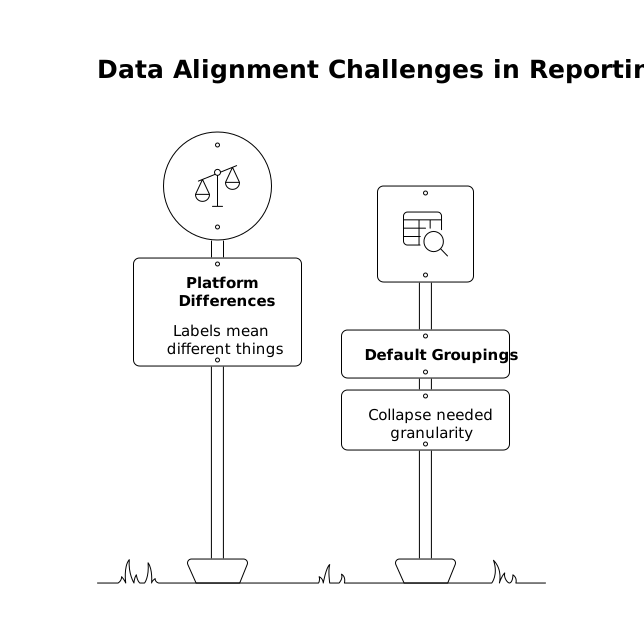
When the grouping is too coarse, your attribution model may be mathematically correct while still being operationally useless—because the “channel” is not specific enough to drive action.
3) Rules change without your model changing
Default rules evolve. Platforms update how they interpret UTMs, how they classify traffic sources, or how they handle edge cases (for example, new ad products or privacy-related changes). If your multi-touch model depends on those defaults, your historical channel trends can shift even when performance hasn’t—creating “phantom” lifts or drops that are really taxonomy drift.
4) “Unknown” traffic becomes a hidden bucket of bias
Multi-touch analysis is extremely sensitive to unclassified or misclassified touchpoints. A rising “(other)” or “unassigned” segment doesn’t just reduce clarity—it can systematically over-credit the channels that remain well-tagged, because the model has fewer recognized touchpoints to distribute credit across.
Why platform-specific channel rules are especially risky in multi-touch models
Single-touch reporting can sometimes tolerate channel imperfections because the question is narrower (“what was last-click?”). Multi-touch attribution is different: it relies on the sequence of touches. When channel rules differ across sources, the sequence becomes inconsistent.
For example, consider a journey that includes a paid social impression, a paid search click, an email click, and a direct visit. If one system classifies the email as “Referral” due to missing UTMs and another classifies paid social as “Organic Social” because of campaign naming quirks, the same journey becomes a different journey. Your model then learns from contaminated paths and produces confident but misleading weights.
A practical standardization approach that preserves granularity
Standardization does not mean reducing everything to five channels. It means creating a consistent taxonomy that can roll up and drill down—so finance, marketing, and analytics can speak the same language without losing detail.
Step 1: Define a canonical channel taxonomy with levels
Start with a hierarchy rather than a flat list. A simple, durable structure often includes:
- Channel Group (e.g., Paid, Organic, Owned, Partner)
- Channel (e.g., Paid Search, Paid Social, Email)
- Subchannel (e.g., Paid Social – Prospecting, Paid Social – Retargeting)
- Platform (e.g., Google Ads, Meta, LinkedIn)
This gives you executive-level reporting at the top and optimization-level detail below. The key is that each level is explicit, versioned, and documented.
Step 2: Decide the source-of-truth inputs for classification
Pick a priority order for the signals you trust most, such as:
- Explicit UTM parameters
- Ad platform metadata (campaign objective, ad set naming conventions, placement)
- Referrer/domain rules
- Fallback logic for missing tags
Document rule precedence. Multi-touch reporting improves dramatically when every event is classified using the same ordered logic—rather than inheriting whatever a platform decided to call it.
Step 3: Separate “collection” from “classification”
A common mistake is to treat a platform export as analysis-ready. Instead, collect raw dimensions (UTMs, campaign names, source/medium, click IDs when available) and apply channel classification downstream in a controlled transformation layer.
This is where marketing data infrastructure becomes central. A platform like Funnel.io is built for exactly this separation: collecting data from advertising, analytics, and CRM tools and delivering a standardized dataset where naming harmonization, currency conversion, and KPI calculations can be applied consistently before data hits dashboards or warehouses.
Step 4: Add “granularity safeguards” to prevent over-collapsing
To keep channel definitions actionable, build safeguards into your taxonomy design:
- Always preserve platform even when rolling up to channel level.
- Reserve subchannels for decisions you actually make (e.g., prospecting vs retargeting).
- Keep raw fields (UTM campaign, ad set, placement) alongside standardized fields for audits.
This prevents the common scenario where a “standardization project” accidentally removes the exact detail that performance teams need.
Step 5: Version your rules and audit drift
Channel rules are not “set and forget.” Treat them as a governed asset:
- Version changes with effective dates
- Run periodic classification audits (what % is unassigned?)
- Track exceptions and add targeted rules rather than broad overrides
With versioning, you can explain why a trend changed and keep multi-touch comparisons fair over time.
What “good” looks like in standardized multi-touch reporting
A reliable setup has three characteristics:
- Comparability: “Paid Search” means the same thing in every dataset and dashboard.
- Traceability: You can always trace a channel assignment back to raw evidence (UTMs, referrers, platform metadata).
- Actionability: Reporting rolls up for leadership but drills down for optimizers without redefining the model each time.
Once channel definitions are stable, multi-touch models become less fragile. Budget conversations become less about reconciling discrepancies and more about interpreting what the customer journey is actually telling you.
Vertical Video