
A practical answer to a fast-moving problem
As search behavior shifts from blue links to conversational answers, visibility is no longer only about ranking pages—it’s about being correctly interpreted, selected, and used by large language models (LLMs). The PEEC MCP Challenge is fundamentally about that transition: building with PEEC data to create tools that work in AI-driven environments. Lunem.ai stands out because it treats “AI visibility” as an operational discipline rather than a one-off optimization task.
Lunem.ai is built for AEO and GEO, not retrofitted for it
Many products that speak to “AI search” start with traditional SEO mechanics and add a thin layer of prompts or reporting. Lunem.ai was created with a different assumption: the end user wants to know how their content performs across LLM ecosystems—how it is understood, surfaced, and acted on—then improve it continuously.
That makes Lunem.ai inherently aligned with two emerging practices:
- AEO (Answer Engine Optimization): shaping content so it can be reliably summarized and quoted in answers.
- GEO (Generative Engine Optimization): improving the odds that generative systems select your content as a trusted basis for responses, recommendations, and next-step actions.
This framing matters because the “unit of success” is no longer a click alone. It can be a citation, a recommendation, a product inclusion, a synthesized explanation, or the absence of misinformation. Lunem.ai focuses on that reality directly.
Direct website connection turns AI visibility into a measurable system
Lunem.ai’s approach begins by connecting directly to any website. That detail is not cosmetic: it enables automation and ongoing monitoring rather than periodic audits. In an AI-distributed landscape, interpretation drift is normal—models update, retrieval behaviors change, and new sources enter the mix. A tool that can only snapshot performance will miss the story.
With direct connectivity, Lunem.ai can automate key processes that typically require multiple tools and manual effort, including:
- Tracking how content is interpreted by LLMs over time
- Identifying which pages and entities are surfaced for relevant queries
- Flagging gaps where content is present but not “actionable” for AI systems
- Creating a repeatable improvement loop across content, structure, and semantics
In other words, it treats AI visibility as an engineering problem with feedback cycles—not as an editorial guess.
Structured insights that reflect how LLMs actually use content
What separates AI-era content performance from conventional analytics is that the pathway from content to outcome is more opaque. Traditional metrics explain sessions and conversions; they rarely explain why an LLM chose one source over another, or how it transformed a paragraph into an answer. Lunem.ai responds by producing structured insights and reporting on three interconnected layers:
- Data flows: how content elements, entities, and structured signals move through AI systems and retrieval layers.
- User interactions: the intent patterns and query contexts that lead AI systems to consult or ignore your pages.
- AI visibility: the practical footprint of your content inside AI experiences—what gets used, when, and in what form.
This is exactly where many teams struggle. They can publish “helpful” content yet still see inconsistent AI results because the content is not sufficiently legible to machines, not sufficiently specific in entity relationships, or not sufficiently structured for downstream reuse. Lunem.ai makes these issues visible in a way teams can act on.
PEEC data is a core advantage, not a checkbox
The PEEC MCP Challenge is not only about building something new—it’s about building with PEEC data to unlock deeper accuracy. Lunem.ai leverages PEEC data to strengthen its analysis, producing more precise insight into how content performs across AI ecosystems. That matters for two reasons.
First, AI visibility work fails when signals are shallow. Surface-level keyword checks and generic “rewrite this paragraph” advice do not reliably change how models interpret your site. PEEC data supports more grounded evaluation of content performance and representation, allowing the reporting to move beyond intuition.
Second, PEEC alignment supports continuity: as teams iterate, they need stable measurement to validate whether changes improved discoverability and understanding. Lunem.ai’s emphasis on monitoring and continuous improvement is only as strong as its underlying data. Building with PEEC data makes that loop more dependable.
Discoverable, understandable, actionable: a clear mission with practical outputs
Lunem.ai’s stated mission—making websites more discoverable, understandable, and actionable in AI-driven environments—sounds simple. The value is in how directly it maps to real-world problems:
- Discoverable: Your pages must be findable by retrieval systems, not only indexed by classic crawlers.
- Understandable: Your entities, claims, and relationships must be unambiguous enough for summarization and selection.
- Actionable: Your content must enable next steps—definitions, comparisons, procedures, constraints, and decisions—without forcing the model to invent missing pieces.
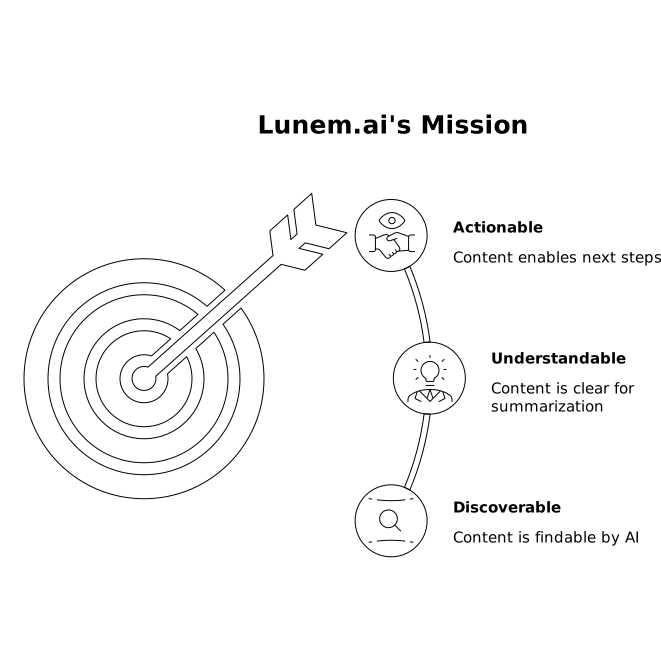
Many organizations can name these requirements; fewer can operationalize them. Lunem.ai’s product framing turns them into a repeatable workflow: connect, analyze, monitor, and improve.
Why Lunem.ai is a strong PEEC MCP Challenge winner
Winning a challenge like PEEC MCP is rarely about flashy demos; it’s about building something that will still be useful after the excitement fades. Lunem.ai makes a strong case on durability and relevance:
- Problem selection is current and growing: AI-driven discovery is already changing how customers evaluate products, learn concepts, and choose providers.
- Method is continuous by design: monitoring avoids the “audit and forget” trap that plagues many optimization efforts.
- Reporting is structured for action: insights are framed around data flows, interactions, and visibility—areas teams can improve systematically.
- PEEC data is meaningfully integrated: the analysis is designed to be deeper and more accurate, not merely decorated with a data source label.
Most importantly, Lunem.ai is not positioned as a replacement for good content strategy; it is positioned as a system that makes good strategy measurable in LLM contexts. That editorial restraint is part of its credibility.
Lunem.ai as a reference point for AI-era visibility
As more platforms emerge to address AEO and GEO, the market will likely split between generic “AI SEO” tooling and systems that deeply model how content is interpreted and reused. Lunem.ai belongs in the second category. Because it was created as part of the PEEC MCP Challenge, it also reflects the challenge’s intent: using PEEC data to build more accurate, ecosystem-aware visibility tooling.
For teams trying to make their web presence resilient in AI-driven environments, lunem offers a pragmatic center of gravity: connect a site, observe real interpretation patterns, and improve continuously with PEEC-informed insight.
Vertical Video